


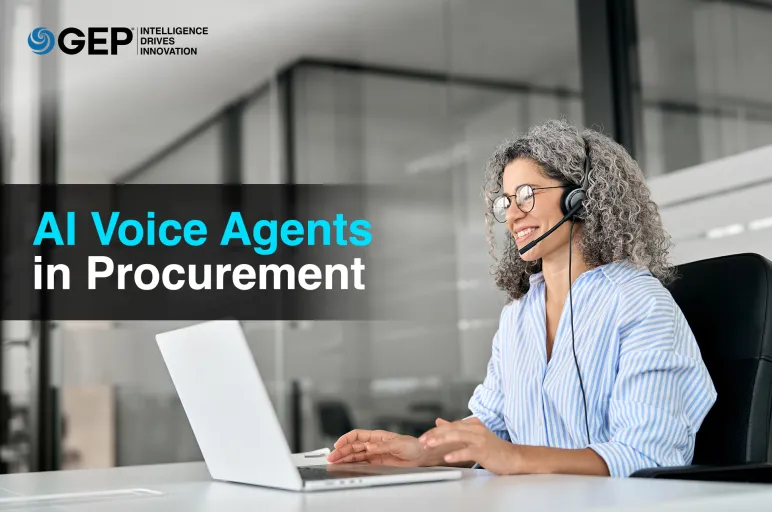
From Forms to Conversation: Leveraging AI Voice Agents in Procurement
- Voice agents fix procurement delays by cleaning up intake at the first interaction.
- Conversational AI reduces rework by enforcing policy while requests are still forming.
- Procurement teams gain speed and control when systems respond to speech, not forms.
January 05, 2026 | Procurement Software 4 minutes read
Procurement work still starts the same way in many companies. Someone emails a request. Another person follows up with a spreadsheet. A third asks for missing details. Days pass before anything enters a system. That delay rarely shows up on dashboards, but it shapes how procurement is perceived across the business.
Teams look slow when the real issue sits upstream. Intake remains manual, fragmented, and dependent on people translating business needs into procurement language. Voice technology now steps into that gap. AI voice agents change how requests enter procurement, how questions get answered, and how routine work moves forward without waiting for forms, tickets, or training.
Understanding Voice Agents in Procurement
Voice agents are not chatbots with a microphone attached. They are conversational systems that listen, interpret intent, and act inside procurement workflows. Employees speak naturally, describing what they need, when they need it, and why. The agent converts that conversation into structured data that procurement systems can process. That includes category, budget signals, urgency, and compliance checks.
Unlike static assistants, modern voice agents operate continuously. They learn terminology, supplier names, and internal policies over time. GEP notes that poor intake quality remains one of the biggest contributors to rework and cycle delays across source-to-pay processes. Voice agents target that exact problem by capturing demand correctly at the first interaction.
Ready for the Next Disruption?
Explore how autonomous AI agents are driving procurement transformation
How Do Voice Agents Function in Procurement?
A voice interaction starts with speech recognition, but the real work happens after that. Natural language processing extracts intent and context from the conversation. The agent then checks that input against procurement rules. It identifies whether an approved supplier exists, whether a contract applies, and whether spend thresholds trigger review. If information is missing, the agent asks follow-up questions in plain language. Once the request meets policy, the agent routes it automatically into the right workflow. That could mean creating a requisition, starting a sourcing event, or directing the user to a catalog.
Gartner notes that conversational interfaces reduce training effort because users no longer need to understand system navigation before submitting compliant requests. The system adapts to the user instead.
Key Features of Voice Agents in Procurement
Not every conversational tool works in procurement. The following features separate voice agents that support controlled intake from those that create more noise.
Context-Aware Intake
Effective voice agents recognize business-specific language, including internal project names and supplier references. They understand intent beyond keywords and retain context across a conversation, even when users pause or change direction. That capability prevents restarts and reduces frustration during intake.
Policy and Compliance Checks in Real Time
Voice agents operate within procurement rules. They validate spend thresholds, approval paths, and sourcing requirements as the conversation unfolds. Requests that fall outside policy trigger guided follow-ups or escalation rather than slipping through informal channels.
Secure Identity and Access Control
Security remains intact. Voice agents verify user identity and permissions before taking action. Access rights determine what data the agent can retrieve and which workflows it can initiate, ensuring segregation of duties stays enforced.
System Integration and Workflow Execution
Integration with procurement platforms allows voice agents to create records, update status, and retrieve information instantly. The conversation translates directly into system actions rather than sitting as unstructured notes.
Auditability and Traceability
Every interaction is logged, time-stamped, and linked to downstream transactions. Everest Group research shows adoption improves when conversational tools provide clear governance and audit trails, especially in regulated industries.
GEP Outlook Report 2026
Explore the dynamics shaping procurement & supply chain and know how to navigate them in 2026
How Voice Agents Benefit Procurement Operations
The most visible benefit shows up in speed for AI-powered procurement software. Requests move from conversation to system entry in minutes instead of days. That reduces intake backlogs and frees buyers from administrative cleanup. Data quality improves because the agent validates inputs before submission. Fewer incomplete requests mean fewer clarification loops later.
Procurement teams gain better visibility into early demand signals, which supports planning and supplier engagement. Stakeholders experience less friction because they interact in a familiar way. Over time, voice agents reduce reliance on email and messaging apps for procurement requests. GEP analysis indicates that organizations using guided intake report shorter cycle times and fewer policy exceptions. Voice agents extend that guidance to the moment demand arises.
Looking Forward: The Future of Procurement with Conversational AI
Voice agents will not replace procurement professionals. They will change where effort goes. Routine interactions will happen conversationally, leaving teams focused on negotiation, risk, and supplier performance. As agents connect to broader AI models, they will anticipate needs based on historical behavior and operational data. A plant manager may receive a prompt before inventory runs low. A project lead may hear contract options before asking.
Success depends on trust, clean data, and governance. Voice works only when procurement systems are unified. Organizations that embed conversational AI into their core platform will shorten cycles, reduce friction, and gain earlier control over spend. Procurement stops waiting for requests and starts responding in real time, one conversation at a time.



FAQs
Procurement voice agents operate within the same identity, access, and audit controls as core procurement systems. Every interaction is logged, permissions are enforced, and sensitive actions require validated authorization.
Yes, modern voice agents connect directly to source-to-pay platforms, ERPs, and contract systems through standard APIs. That integration allows conversations to trigger real transactions rather than sitting outside the workflow.
Industries with high request volume and distributed stakeholders see the fastest impact, including manufacturing, healthcare, retail, and energy. Any environment where intake delays slow operations stands to gain from conversational procurement.