



Dirty Data Draining Your Budget? Use AI Data Cleansing for Spend Optimization
- Inaccurate procurement data creates hidden costs and operational risks, but automated cleansing turns raw numbers into trustworthy strategic assets.
- Moving from periodic spreadsheet cleanups to continuous AI-powered data hygiene is essential for accurate forecasting and real-time risk management.
- AI classification tools automate the categorization process, allowing finance and procurement teams to focus on high-value analysis rather than manual repairs.
January 14, 2026 | Procurement Software 5 minutes read
Data Cleansing for Spend Optimization Using AI
Imagine a CFO trying to negotiate a global laptop contract. They run a report and quickly realize the company’s spend is all over the place — some teams list the supplier as “Dell,” others as “Dell Inc.,” and plenty more are buying through third-party resellers tucked under vague, catch-all categories.
The numbers don't add up, the volume discount is lost and the opportunity for spend optimization vanishes. This is the reality of dirty data, and it drags down procurement performance.
For years, finance teams have treated data issues as a messy byproduct of doing business that requires manual intervention. However, data is only an asset if it is usable. AI data cleansing for spend optimization is now a critical bridge between chaotic raw inputs and clear, actionable financial strategy.
Understanding Data Cleansing with AI
Data cleansing, also known as data cleaning or data scrubbing, involves identifying and correcting errors, inconsistencies and inaccuracies in datasets. In procurement, this means fixing duplicate supplier entries, standardizing currency formats, filling in missing line-item details and removing obsolete records.
Traditionally, data cleansing was a rules-based process. A human would tell a computer, "If the name says IBM, change it to International Business Machines." But what happens when a new entry appears as "I.B.M. Corp"? A rigid rule might miss it. This is where AI comes in.
AI understands context, using machine learning and natural language processing (NLP) to recognize that a purchase order for "Apples" from a catering vendor is food, while a purchase order for "Apples" from an electronics vendor is IT hardware. AI allows teams to maintain clean procurement data at a scale that traditional methods can’t match.
Why Is Continuous Data Cleansing Crucial Today?
Supply chains are volatile, and pricing structures can fluctuate daily. If you only clean your data once a quarter, any insights you gain will be expired by the time you act on them.
Bad data creates a domino effect of inefficiency. It obscures maverick spend and hides supplier risk. If you can’t see who you are spending with because the supplier names vary across business units, you can’t assess their stability or compliance.
AI-powered spend management software is designed to combat these problems. These platforms rely on a foundation of continuously scrubbed data that lets procurement leaders pivot strategies instantly, instead of waiting for end-of-month reports to reveal what went wrong.
Check GEP’s - AI Spend Management Software
Key Factors Influencing Data Quality
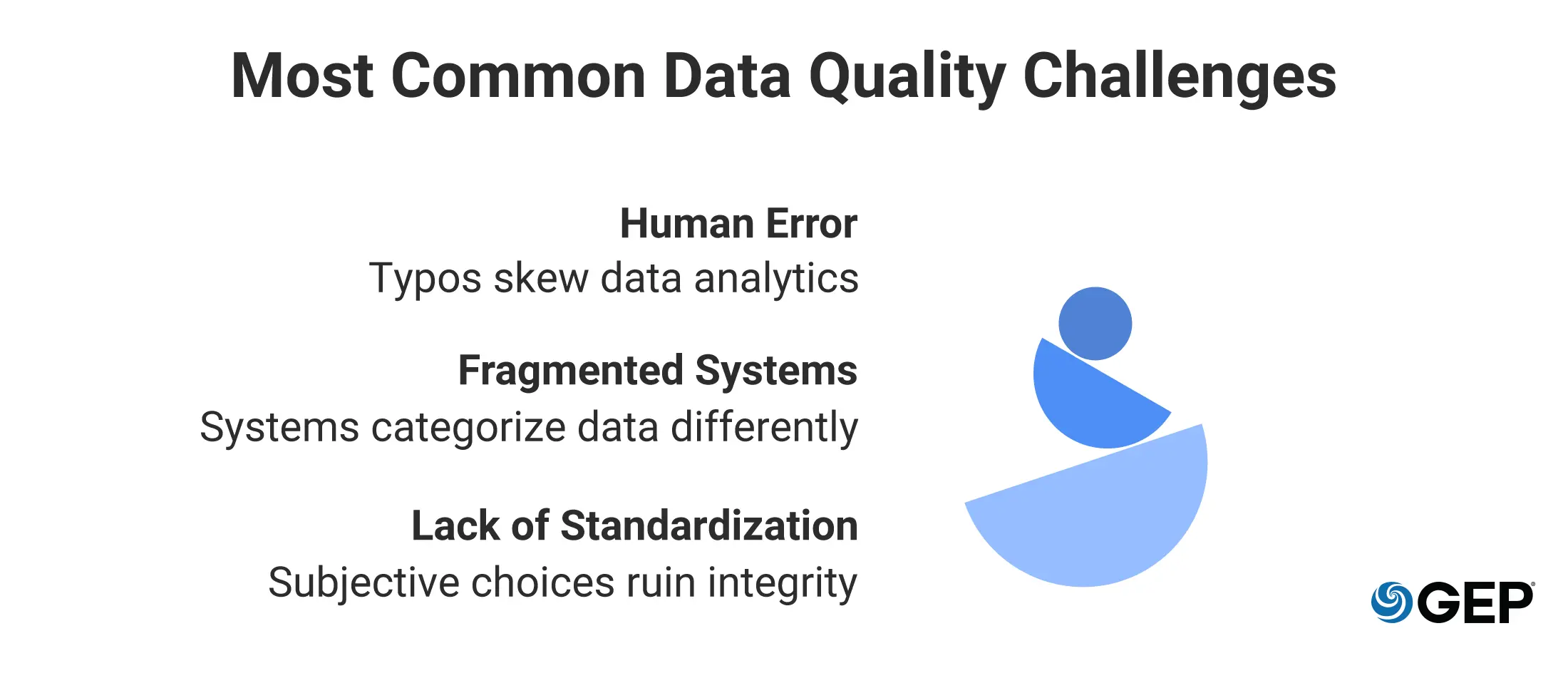
Why does data get so "dirty"? It’s usually the result of systemic complexities:
Human Error:
Simple typos during manual entry are the most common culprits. A vendor invoice entered as $10,000 instead of $1,000 due to a misplaced decimal can skew an entire category's analytics.
Fragmented Systems:
Large organizations may run multiple ERPs that categorize data differently. When these systems try to talk to each other without a unified translation layer, data cleansing becomes a nightmare.
Lack of Standardization:
Without a strict taxonomy, subjective choices ruin data integrity. One employee might classify a chair as "Office Supplies," while another classifies it as "Furniture." Both are technically correct, but this inconsistency breaks spend visibility.
Here’s How to Protect Procurement Savings
Fix the Alignment, Process and Technology Gaps That Are Eroding Your Savings
Contact Us
How Often Should You Perform Data Cleansing?
For spend optimization, an "always-on" approach is best. Data cleaning should occur as data enters the system.
However, specific events should trigger deeper, audit-level cleansing cycles. These include mergers and acquisitions (where two messy datasets collide), system migrations, or major supplier negotiation periods.
Continuous maintenance ensures that when you need to run a complex report, you aren't wasting the first week just fixing the inputs.
How AI Enhances and Streamlines Data Cleansing
AI-powered data cleansing is an exponential leap over manual cleansing. A human analyst might be able to review and standardize 50 records an hour. An AI model can process millions of lines of transaction data in minutes.
AI also brings sophisticated pattern recognition to the table. It can identify anomalies that look correct to a simple software rule but are actually fraudulent or erroneous. For example, AI can flag a duplicate payment even if the invoice numbers are slightly different (e.g., "INV-1001" vs. "INV1001") by comparing dates, amounts and vendor metadata.
In addition, every time a human verifies a correction, the model gets smarter. If the AI flags a weird transaction and a human confirms it is valid, the AI adjusts its parameters for next time, progressively reducing false positives and making the data cleansing process smoother with every cycle.
Transform Your Data Cleansing Process With AI Classification Tools
Categorizing spend, i.e., putting every messy line item into the right bucket, is the most exhausting part of analysis. This is where modern data cleansing tools prove their worth.
Take a hypothetical global manufacturer that appears to be bleeding cash on "Maintenance Services." When they switch to AI classification, they might find that 30% of that spend is actually "Capital Equipment," mislabeled by managers trying to skirt the strict CapEx approval process. Unlike a spreadsheet, the AI reads the description, price and vendor history to catch these nuances and reclassify the items automatically.
Suddenly, the OpEx budget reflects reality, and the finance team isn't wasting weeks manually auditing rows. It turns a data mess into a strategic win.
Clean Spend Data Is the Fuel for Your Procurement Function
Data is the fuel for the modern enterprise, but if that fuel is contaminated, the engine will eventually stall. That means that data cleansing is no longer a back-office administrative task; it’s essential for spend optimization.
By adopting AI-driven solutions, finance and procurement leaders can move past the chaos of dirty data. They can ensure accuracy, drive compliance and uncover savings opportunities previously hidden in the noise. To optimize spend, you have to be able to trust that your data is consistently clean, and only AI makes that trust possible.




FAQs
Poor data quality leads to a "garbage in, garbage out" scenario, rendering AI insights flawed and financial decisions inaccurate. Without clean inputs, opportunities for savings are masked by errors and inconsistencies.
Key factors include human entry errors, duplicate records, incomplete fields and fragmented systems that lack a unified taxonomy.
AI automates data cleansing by learning context and patterns, processing millions of lines of data vastly faster and more accurately than rigid manual rules.
Success is measured by quantifiable metrics such as higher classification rates, fewer duplicate records and significantly faster reporting cycles.
Clean data provides the visibility needed to identify unauthorized "maverick" spend, aggregate small "tail spend" for discounts, and accurately map supplier risks.
Enterprises often see drastic reductions in unmanaged spend and faster reporting times, frequently uncovering 5-20% in previously hidden savings opportunities.
GEP SMART procurement software leverages patented AI, vast data models and expert human oversight to ensure high classification accuracy for Fortune 500 and Global 2000 enterprises across industries. Read more here.