



How Generative AI Breathes New Life Into Zero-Based Budgeting
- Generative AI transforms zero-based budgeting (ZBB) from a manual, spreadsheet-heavy slog into a continuous, strategic financial engine.
- AI agents reduce the time needed for accurate cost forecasting and approval by automating data analysis and justification narratives.
- To implement AI successfully, companies need to overcome data silos and train models on clean historical spend data to avoid "black box" distrust.
January 13, 2026 | Procurement Software 5 minutes read
The concept of Zero-Based Budgeting (ZBB) has always seemed great in theory. Building a budget from scratch every year ensures that every dollar spent is justified.
However, the traditional budgeting process is labor-intensive. That’s why many organizations abandon true ZBB in favor of easier, incremental budgeting taking last year’s numbers and adding 5%. But this approach allows inefficiencies to hide and compound over time.
Generative AI is removing the administrative friction that has historically made ZBB difficult to sustain. AI agents that observe, reason and adapt to financial data can help companies realize the promise of zero-based budgeting without the burnout.
Redefining Zero-Based Budgeting for the Generative AI Era
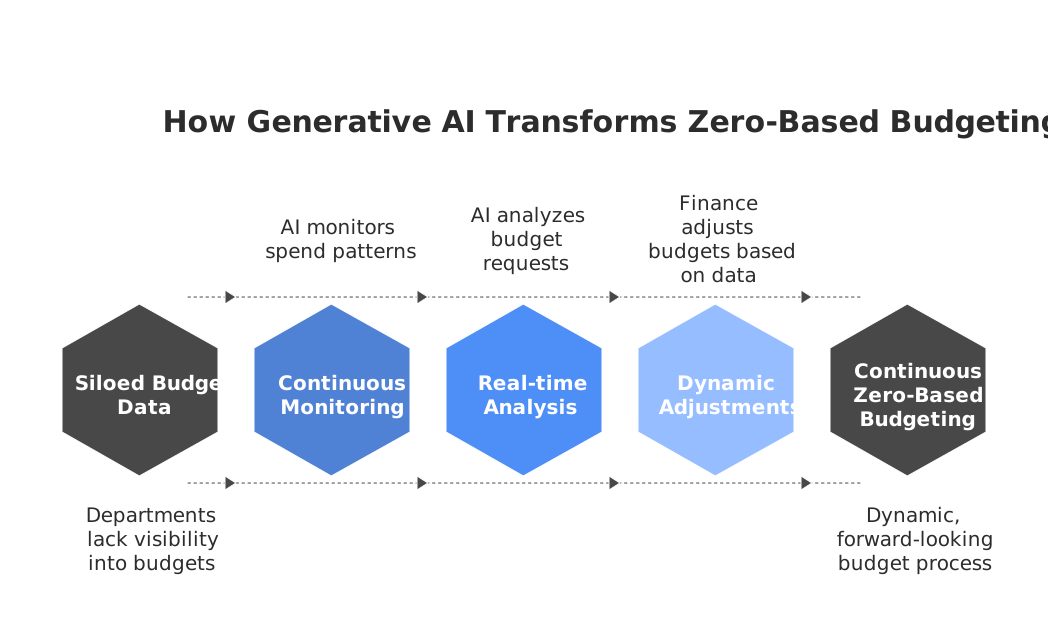
In a standard system, budget data is often trapped in silos. One department cannot see the inventory or spend of another, which forces the corporate office to wait for end-of-month spreadsheets to reconcile what happened. This lag turns ZBB into a retrospective autopsy rather than a forward-looking plan.
Generative AI redefines this by enabling continuous ZBB. Instead of a massive annual reset, AI agents can continuously monitor spend patterns and budget justifications in real-time, analyzing budget requests against strategic goals instantly.
This shift changes the role of the finance team: they don’t have to act as forensic accountants hunting for errors. Rather, AI handles the complex accounting and data tagging in the background, allowing the platform to act as a central nervous system for the organization.
Zero-based budgeting then becomes a more dynamic process, letting finance adjust budgets based on market conditions and performance data, rather than setting them once a year.
How Generative AI Transforms Zero-Based Budgeting for Efficiency and Accuracy
The core area of friction with zero-based budgeting is the justification phase. In a manual budgeting process, a department manager must write a narrative explaining why they need $50,000 for travel or $100,000 for software. This is subjective and prone to "sandbagging," where managers inflate their requests expecting them to be cut.
Automating zero-based budgeting with generative AI makes this process more efficient. AI agents can act similarly to how they evaluate RFP responses: they read and understand the request, break it down into scorable components and check it against historical data and corporate policy.
Discover Now GEP’s - Zero Based Budgeting Consultation Solution
Here is how AI drives specific improvements:
Automated Justification Analysis:
When a manager submits a budget request—say, a 20% bump in marketing spend—an AI agent can immediately pull up relevant benchmarks and historical data. Did the last increase of that size actually drive proportional revenue growth? The comparison happens in seconds rather than hours of manual digging.
Bias elimination:
We all have off days. We all carry unconscious biases into our work. AI doesn't deal with either of those issues. Every single budget line gets measured against the same ZBB criteria, which creates a more level playing field across the board.
Speed and Scale:
These systems can tear through hundreds of pages in minutes. An AI agent working overnight can review thousands of line items across a multi-entity organization and flag only a handful of anomalies that need human judgment.
The upshot? Finance teams stop chasing paperwork and start focusing on strategic decisions that actually move the needle.
Practical Examples of Generative AI in Zero-Based Budgeting (ZBB)
A couple of real-world scenarios help show what this looks like in practice:
Example 1: The "Sandbagging" Detector in IT Operations
A CIO submits a flat cloud budget same as last year. On the surface, it looks stable and reasonable. But the AI agent notices something: the company recently divested a business unit. When it calculates cost per employee, that number has quietly skyrocketed. The system flags the discrepancy and determines the real need is about 15% lower. What looked like a routine approval turns out to be an "invisible leak" that would have slipped through otherwise.
Example 2: Optimizing Marketing Spend ROI
A regional director requests $500,000 for a traditional print campaign. The AI digs into five years of global performance data and finds that this channel's ROI has been dropping steadily—down roughly 40% year-over-year. Instead of rubber-stamping the request, it suggests capping print at $200,000 and reallocating the rest to digital channels that are actually delivering results. A routine budget approval becomes a strategic conversation about growth.
Manage Spend Smarter With AI
Unlock Better Forecasting, Budgeting and Benchmarking Now
Watch the Webcast Now
Challenges While Adopting Generative AI in Zero-Based Budgeting (ZBB)
While the benefits are transformative, CFOs must navigate real hurdles to successfully implement AI for zero-based budgeting.
Data Fragmentation:
The biggest enemy of AI is bad data. If your organization suffers from data fragmentation—where a single vendor is listed under multiple names like "Acme Corp" and "Acme Inc."—the AI cannot run accurate reports or leverage total spend insights. For AI to build a reliable ZBB model, the underlying data must be clean, consistent, and well-structured.
The "Black Box" Problem:
Budget owners need to trust the numbers. If an AI agent cuts a budget request by 10% without explanation, the manager will revolt. This is known as the "Black Box" problem, where users distrust scores or decisions if the reasoning is opaque. Organizations must ensure their AI tools offer transparency through audit trails, showing exactly why a specific cost was flagged or rejected.
Change Management:
Local teams often fear centralization and automation because they worry about losing agility or autonomy. Implementing AI for ZBB requires a cultural shift. Leaders must demonstrate that AI is not a "gatekeeper" stopping them from spending, but a strategic partner that helps them get their budgets approved faster by ensuring they are compliant and realistic from day one.
Making ZBB Scalable, Precise and Continuous
Generative AI is doing for Zero-Based Budgeting what automation did for manufacturing: taking a process that was once painfully manual and expensive and making it scalable, precise, and continuous.
Integrating AI into the financial planning stack will allow organizations to finally close the gap between the theoretical benefits of ZBB and the practical reality of executing it.
It allows companies to stop relying on "last year plus 5%" logic and start building budgets that reflect the true reality of their operations. As these platforms evolve, they will turn procurement and finance from administrative bottlenecks into strategic value creators, ensuring that profit margins don’t shrink due to operational inefficiency as the business grows.




FAQs
Gen AI improves accuracy by using predictive analytics to spot data anomalies humans often miss. It replaces subjective estimates with objective baselines derived from real-time performance.
Challenges include data fragmentation, which obscures total spend visibility, and the "black box" problem, where users mistrust AI adjustments that lack transparent reasoning.
CFOs should start small with low-risk tasks before scaling up. Prioritizing data hygiene is critical, as AI models are only as effective as the clean data they are trained on.