


Generative AI in Spend Management: The Next Frontier in Finance
- Generative AI is reshaping how companies handle spend management by unifying scattered data and taking over manual, time-consuming tasks.
- The payoff includes lower costs, tighter compliance and the ability to see what's happening with your spending as it happens, not weeks later in a report.
- Making AI-powered spend management work requires clean data, systems that integrate without constant IT intervention, and a clear vision for how AI fits into your operations.
December 02, 2025 | Procurement Software 5 minutes read
For years, digital changes in finance, like in buying and paying, only brought small gains. Companies moved from paper files to digital, but this did not give leaders a real strategic edge.
Now, generative AI is here, and it’s completely changing how a business analyzes and controls its spending. Gen AI turns a simple, everyday job into a major source of strategic value.
Spend management means guiding all purchases from start to end. The goal is simple: maximize value and minimize risk. The challenge is the massive amount of scattered data, like contracts and bills, that legacy systems cannot handle. This is where the true power of Gen AI comes in.
How Generative AI Is Reshaping Procurement & Spend Management
Generative AI learns patterns from massive datasets and uses them to create new content or surface insights. The technology excels at generating content (like contract drafts), analyzing spending patterns and letting anyone ask questions in plain English instead of building complex reports.
For procurement teams, this means handing off tedious work like data cleanup, spend categorization and routine analysis to AI systems that handle it faster and with fewer mistakes.
Contract reviews that used to take days now take minutes, with AI pulling out key terms, obligations, and red flags automatically. That frees up your team to negotiate better deals instead of just reading documents.
Why Spend Management Needs a Generative AI Makeover
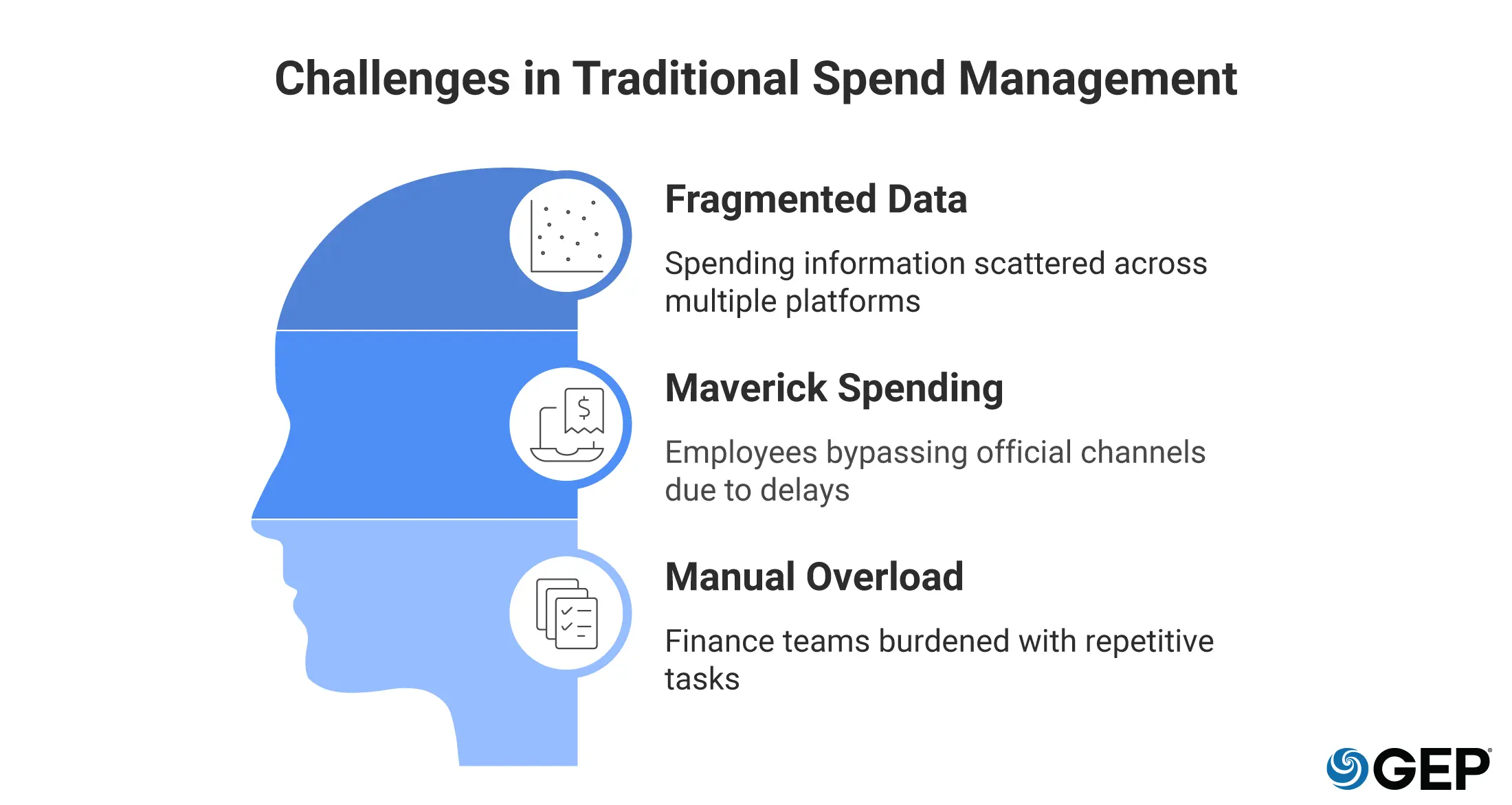
Traditional spend management systems weren't built to solve the problems companies face:
Fragmented Data:
Your spending information lives in a dozen different places: ERP, expense platforms, procurement tools, and none of them talk to each other.
Maverick Spending:
People often bypass official channels because submitting a purchase request takes too long. This leads to non-compliant purchases that create compliance headaches.
Manual Overload:
Your finance team spends hours on grunt work like invoice matching and classifying line items instead of doing strategic work.
Generative AI addresses these issues by accurately categorizing spending data at scale, giving you visibility into areas like tail spend. More importantly, it lets finance teams ask questions and get answers instantly.
The Role of Generative AI in Spend Management
Gen AI acts as an intelligent co-pilot and analyst, boosting human work across the purchasing process. In analytics, it’s a game-changer, offering predictive insights and helping teams answer "How can we optimize spending?" Specific applications include:
Spend Analysis and Contracts:
Gen AI finds non-compliant purchases and analyzes contracts for risks, renewal dates and cost-saving opportunities like supplier consolidation.
Intelligent Budgeting:
Gen AI tools simplify approvals. An AI Assistant can estimate costs up front, giving control at the start of the process.
Autonomous Negotiation:
For common, low-value purchases, Gen AI can negotiate on its own, freeing up strategic buyers for high-value events.
Gen AI handles the routine work. It enables strategic thinking by automating the tactical burden.
Benefits of Using Generative AI in Spend Management
The benefits of generative AI in spend management are measurable, impactful and directly contribute to the bottom line, moving procurement from a cost center to a value driver.
Real Savings on Costs:
Gen AI quickly sifts through all your data to spot maverick spend and finds opportunities for volume discounts or vendor consolidation. This allows teams to cut costs, fix errors and make smarter financial choices with real-time insights.
Faster Operations and Efficiency:
By automating the routine work, your team doesn’t have to do paperwork and can focus instead on strategic work that matters most.
Built-in Risk and Compliance Guardrails:
AI acts as a watchdog, monitoring every transaction as it happens. It instantly flags anything suspicious: fraud, duplicate payments or simply an employee buying outside of company rules. This constant check keeps you audit-ready and strengthens your internal controls.
Is Your Procurement Team Ready for AI?
Learn How Leading Enterprises Are Optimizing Cost, Speed and Resilience
Challenges & Considerations of Implementing Generative AI in Spend Management
While the promise is clear, the path to implementation has its own set of hurdles. Addressing those challenges requires careful planning.
The most critical factor is data quality. Gen AI models are only as good as the data they are trained on. Poor, inconsistent or incomplete data will lead to inaccurate insights and misinformed decisions. Organizations must invest in data cleansing and normalization as a foundational step.
Beyond data, successful adoption of generative AI also requires:
Integration:
Gen AI solutions must seamlessly integrate with existing enterprise systems, such as ERP platforms, to avoid creating new data silos or disrupting established workflows.
Security and Governance:
Dealing with sensitive contract, supplier and financial data means data privacy and security must be paramount. Organizations need robust safeguards to protect intellectual property and adhere to global data regulations.
Change Management:
Procurement professionals must be trained on how to work with the new technology. Gen AI is not a replacement for human expertise but a powerful augmentative tool that can free teams to apply their judgment and strategic thinking to more complex challenges.
A Real-World Use Case of Generative AI in Spend Management
Consider a hypothetical, multinational retail company. They’re using generative AI to manage their tail spend more effectively.
The AI-powered spend management software looks at two years of unstructured invoice data and classifies spend with over 90% accuracy. That analysis reveals that the company is purchasing the same office supplies from 120 different non-preferred suppliers.
The system then generates an executive The system then generates an executive report quantifying the wasted spend and strategically recommends consolidating the top ten tail spend categories under just three preferred vendors.
By leveraging the AI’s synthesized data, the procurement team executes a high-impact negotiation in weeks, a task that previously took months of manual effort, leading to multi-million-dollar savings in the first year.
Gen AI Is a Practical Necessity for Spend Management
The bottom line: spend management powered by generative AI is now a practical necessity for any organization serious about maintaining a competitive edge.
Companies can overcome fragmented data and manual processes and empower their procurement and finance teams to move beyond cost control and strategically drive business value.
Efficient, optimized and compliant spending is here, and it’s powered by Generative AI.




FAQ
Generative AI improves spend management by classifying fragmented spend data, automating manual tasks like contract summarization and invoice matching and providing predictive insights for strategic decision-making.
The first step is to conduct an AI readiness assessment, which involves prioritizing high-impact use cases and investing in data cleansing and normalization to ensure the AI models have high-quality training data.
Yes, Gen AI helps by monitoring transactions in real-time to instantly flag anomalies like fraud or non-compliant purchases. It analyzes contracts to ensure adherence to company policies and regulatory requirements.