Agentic AI and Industry Expertise Propel GEP to Leaders Quadrant in 2026 Gartner® Magic Quadrant™ for Source-to-Pay Suites
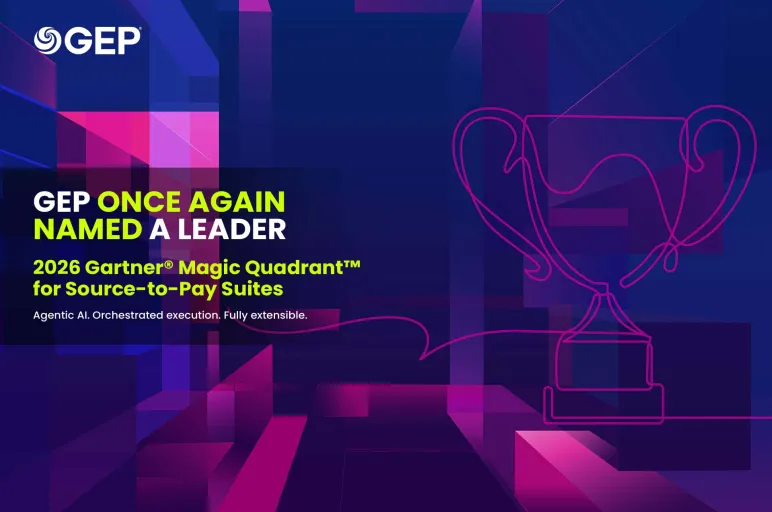
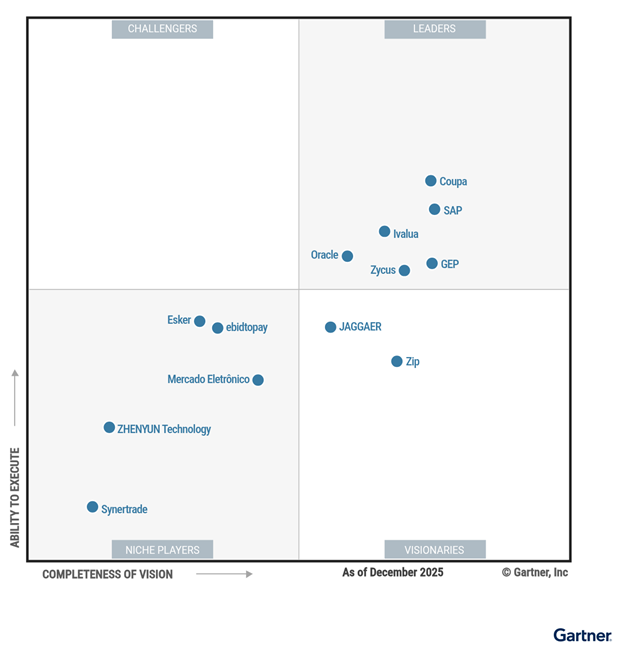
- GEP earned a spot in the Leaders quadrant of Gartner's 2026 Magic Quadrant for Source-to-Pay Suites, reinforcing its position as a top-tier procurement technology provider.
- The company's enterprise-grade agentic AI system, GEP Quantum Intelligence, demonstrates a forward-thinking product strategy that empowers clients to build and deploy their own AI agents.
- Deep industry expertise and expanded partnership channels position GEP to serve complex procurement needs across regulated sectors and diverse market segments.
February 10, 2026 | Procurement Software 3 minutes read
GEP is recognized as a Leader in Gartner's 2026 Magic Quadrant for Source-to-Pay Suites.
Notably, GEP achieved the highest score on completeness of vision among all vendors evaluated in the report. The recognition positions GEP as a top procurement technology provider and validates the company's approach to solving enterprise procurement challenges.
"We believe Gartner recognizing us as a Leader in this year's Magic Quadrant reflects the strength of our agentic AI platform, purpose-built from the ground up to automate work, solve complexity at scale, and deliver value," said Santosh Nair, GEP's global head of software growth.
Gartner's evaluation highlighted three core strengths for GEP: agentic AI strategy, vertical industry expertise and expanding partner ecosystem.
At a time when procurement teams face pressure to deliver value while managing increased complexity, GEP's capabilities help both midmarket companies and large enterprises address the full spectrum of procurement operations.
GEP Quantum Intelligence: Agentic AI That Sets a New Standard for Procurement Orchestration
GEP's AI approach stands apart because of its comprehensive, platform-based architecture. GEP Quantum Intelligence is an enterprise-grade agentic system built to support autonomous procurement operations through intelligent orchestration.
The System Operates on Three Integrated Layers
- An AI assistant for handling everyday procurement tasks
- Intelligent agents that work autonomously to execute complex workflows without constant human oversight
- AI Studio, which lets clients build and deploy their own customized agents
GEP Quantum Intelligence orchestrates interconnected procurement processes by coordinating multiple intelligent agents that work together.
One agent might analyze spend patterns and identify savings opportunities. Another agent evaluates supplier risk in real time. A third agent optimizes contract terms based on category benchmarks. These agents share information, trigger each other's actions and coordinate their work to complete end-to-end procurement processes.
Many vendors have added AI features to their platforms. But few allow customers to create custom agents that address their unique processes. GEP Quantum Intelligence's AI Studio means organizations can identify opportunities within their own operations and build solutions that deliver immediate value.
Procurement teams have moved beyond asking whether AI will transform their function. They're asking how quickly they can implement AI that adapts to their workflows. They don't want to force their teams to adapt to rigid automation.
GEP's AI-first product strategy shows a commitment to giving customers more control over their procurement technology.
Industry Expertise That Delivers Where Generic Solutions Fail
Procurement organizations in regulated industries face a common frustration. They implement software that works well for basic processes but struggles with the complexity their business actually requires.
Pharmaceutical companies need quality management integrated with supplier selection. Financial services organizations require risk assessment embedded in every sourcing decision. Manufacturing companies must manage intricate supply chain configurations that generic platforms can't handle.
GEP's industry-specific functionality goes beyond surface-level customization. When a healthcare organization sources medical devices, they need several things. Audit trails that satisfy regulatory requirements. Supplier certifications that meet quality standards. Contract terms that protect patient safety.
GEP's vertical expertise means these requirements are built into the platform, not bolted on through expensive customization.
Your Guide to Agentic AI Solutions
Learn the Essential Capabilities to Look for in Enterprise-Ready Agentic AI
Strategic Partnerships Create More Paths to Value
GEP's partnership strategy provides customers with multiple options for implementation and ongoing support. An organization might work with a service provider that has deep expertise in their specific industry or region. They still benefit from GEP's technology platform. This approach also allows GEP to focus more on product innovation rather than building service capabilities.
What Leadership Actually Means
GEP's combination of AI innovation, industry depth and partnership flexibility is helping enterprises move toward autonomous procurement and supply chains that optimize value, reduce risk and deliver competitive advantage.
For organizations evaluating source-to-pay platforms, the distance between leaders and also-rans in the procurement technology market continues to grow. Organizations choosing partners for digital transformation should consider what true leadership looks like when complexity, regulation and competitive pressure all demand more from procurement than ever before.