Not All Agentic AI Is Created Equal: Here’s What Sets GEP Quantum Intelligence Apart
- The enterprise market is flooded with “Agentic AI” solutions that are just basic chatbots bolted onto legacy systems. They claim to be agents but lack true autonomy.
- GEP Quantum Intelligence is different. It moves beyond simple task automation to coordinate complex, cross-functional decisions across the supply chain.
- With an open, system-agnostic architecture, GEP Quantum Intelligence allows CPOs to own their AI strategy, integrating with any data source or LLM rather than being locked into a walled garden.
February 03, 2026 | Procurement Software 4 minutes read
The use cases for how AI can transform procurement convinced you. You’ve finally got budget approval and a strategy to start implementing a solution. Now you’re in a chaotic landscape of vendors, from niche point solutions to massive ERP legacy providers, and they’re all claiming to have "Agentic AI."
Here’s the hard truth: most of what is being sold as "Agentic AI" today is simply automation in a new costume. Gartner estimates that of the thousands of agentic AI vendors, only a small fraction have substantial agentic capabilities – leading the analyst firm to predict that over 40% of agentic AI projects will be canceled by the end of 2027.
Agentic AI solutions are often just standard Large Language Models (LLMs) bolted onto old workflows. They can summarize an email or write a generic RFP, but they can’t reason, plan or govern complex enterprise processes.
GEP Quantum Intelligence is different. Rather than a feature, it’s a digital colleague that proactively orchestrates work across your entire Source-to-Pay (S2P) lifecycle.
To cut through the noise in the market, you need to look at three critical differentiators that separate GEP Quantum Intelligence’s agentic orchestration from simple automation.
1. Orchestration vs. Task Automation: The "Brain" Difference
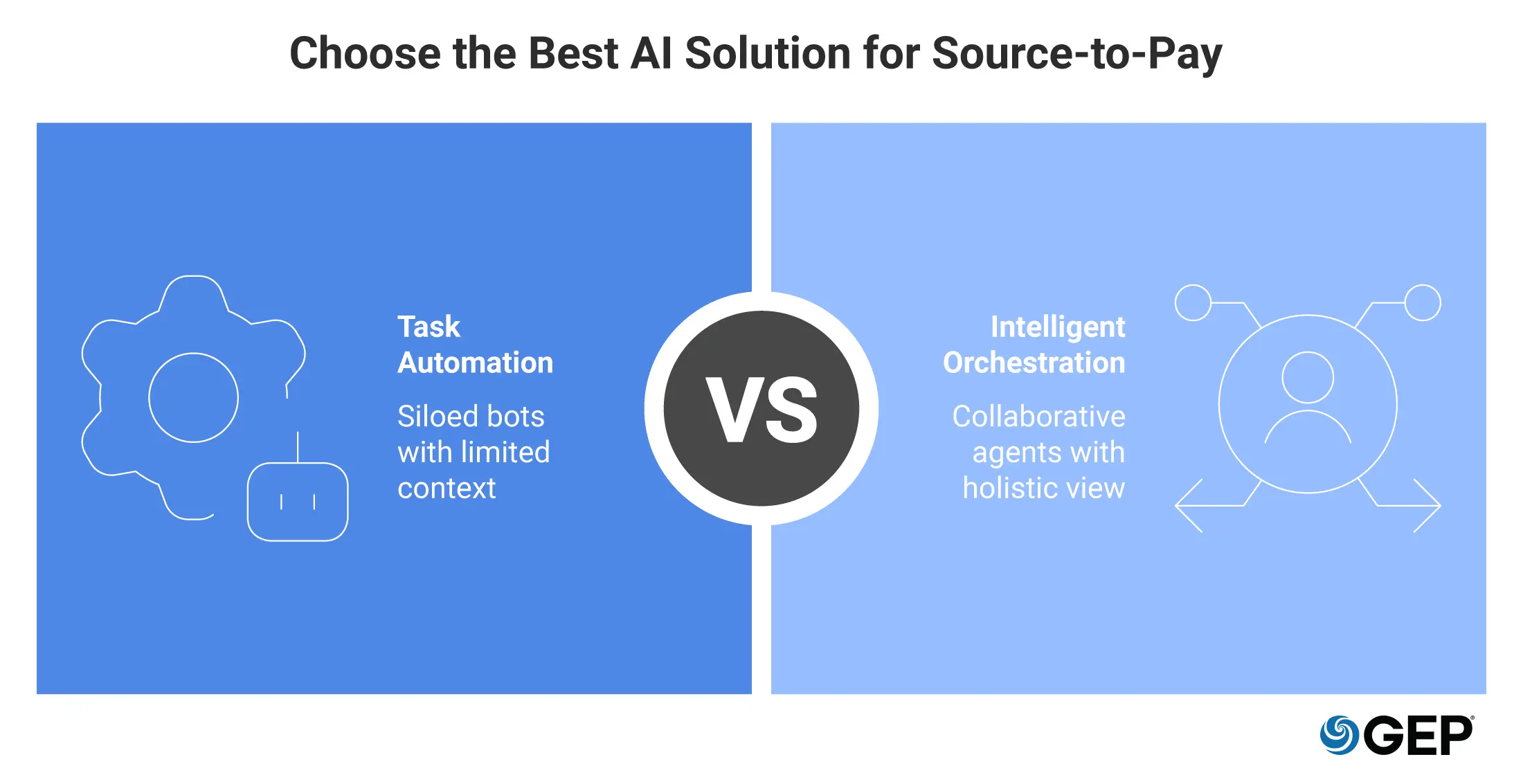
The most significant factor that separates GEP Quantum Intelligence from other solutions is the shift from automation to orchestration.
Most vendors offer task automation. A bot might create a requisition when asked; it’s helpful, but siloed. The bot doesn't know why the requisition is being created or how it impacts the budget or supplier risk profile.
GEP Quantum Intelligence delivers intelligent orchestration across source-to-pay functions, using a network of collaborative agents that think horizontally, not just vertically.
The Competitor approach:
A "Sourcing Bot" helps you write an event. A separate "Risk Bot" checks a supplier. The two bots never speak. You are the bridge.
The GEP Quantum Intelligence approach:
A Market Intelligence Agent identifies a price trend and triggers the Strategy Creation Agent. This agent seamlessly pulls data from the Supplier Risk Agent to ensure the new strategy is compliant before handing it off to the Negotiation Agent for execution.
QI doesn't just do the task; it manages the flow between tasks.
2. Open Architecture: AI Without Handcuffs
Many legacy providers are building walled gardens: they want you to use their AI, on their cloud, trained only on their data formats. If you want to switch LLMs or bring in third-party data, you’re stuck.
GEP Quantum Intelligence is built on an open, extensible architecture:
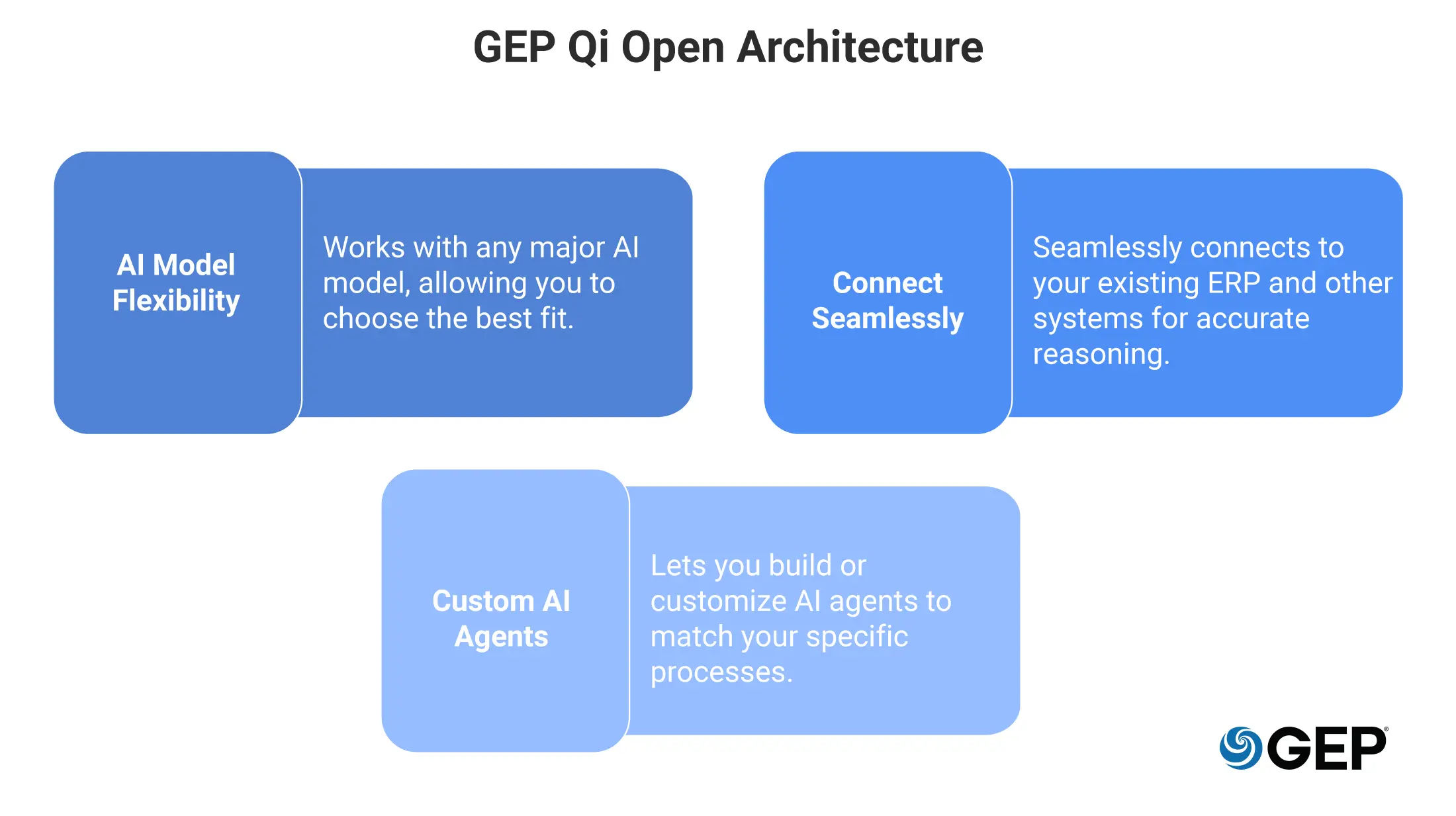
Works with any major AI model.
GEP Quantum Intelligence is LLM-agnostic. It works with different Large Language Models, which are powerful AI models that can interpret what you want and produce the information or actions you need. You can choose the model that fits you best.
Fits into your existing tools.
GEP Quantum Intelligence is system-agnostic. It seamlessly connects to your ERP and other systems to normalize data across system for accurate reasoning and precise actions.
Lets you build your own AI agents.
With GEP Quantum Intelligence Studio, you can create or customize agents so they match your own processes, policies and workflows, while still having the control to define guardrails, permissions and decision policies in line with your organization’s governance and regulatory requirements.
3. Holistic End-to-End vs. Point Solutions
The market is full of point solutions: specialized AI tools that are great at one thing (e.g., autonomous negotiation or contract redlining) but are blind to the rest of the process. GEP Quantum Intelligence provides total orchestration across the entire value chain.
Because it’s built on the GEP Quantum platform, GEP Quantum Intelligence connects upstream demand with downstream payment. Generic AI models often "hallucinate" because they lack this context. GEP Quantum Intelligence agents are able to act with precision because they leverage deep procurement and supply chain expertise, including advanced market intelligence, category insights and historical patterns. And, they continuously learn and improve through outcomes and real-world performance.
The Verdict: Outcomes Over Features
When you strip away the hype around AI, you can talk to a series of chatbots, or interact with an entire system of intelligent agents that are executing end-to-end workflows.
Traditional automation and point solutions can help you make incremental gains in efficiency. But GEP Quantum Intelligence is designed for transformational outcomes: real-time adaptation, continuous self-improvement and the ability to operate at the speed of the market.
Don't settle for AI that just assists. Demand AI that orchestrates.