


How Agentic AI Reduces Manual Intervention in Manufacturing Procurement
- Agentic AI in manufacturing cuts manual intervention across sourcing, buying, and supplier management.
- Agentic AI reduces errors caused by fragmented data and human judgment gaps.
- It frees up time for procurement teams to focus on suppliers and production continuity.
February 23, 2026 | Procurement Software 4 minutes read
Manufacturing procurement runs on tight margins and tighter timelines. A delayed component can idle any production line. A missed contract clause can ripple through cost forecasts for months. But many procurement teams still rely on human effort to monitor demand signals, evaluate suppliers, and trigger actions across disconnected systems.
This aforementioned dependency has limits.
People struggle to keep pace with volatile material prices, shifting demand, and growing compliance requirements. Even well-run teams spend hours reconciling data, chasing approvals, and correcting errors that stem from manual handoffs.
Agentic AI in manufacturing procurement enters this environment with a different operating model. Instead of assisting a buyer task by task, it observes conditions, decides on actions, and executes them within defined guardrails. The result is not fewer people in procurement, but less dependence on human intervention for routine and repeatable decisions that slow manufacturing operations.
Ready for Procurement Success?
Explore how autonomous AI agents can supercharge your procurement transformation
How Agentic AI Reduces Human Dependency in Manufacturing Procurement
Agentic AI reduces dependency by changing who initiates and completes work. In traditional setups, humans detect issues and systems respond. With agentic AI, the system detects, decides, and acts.
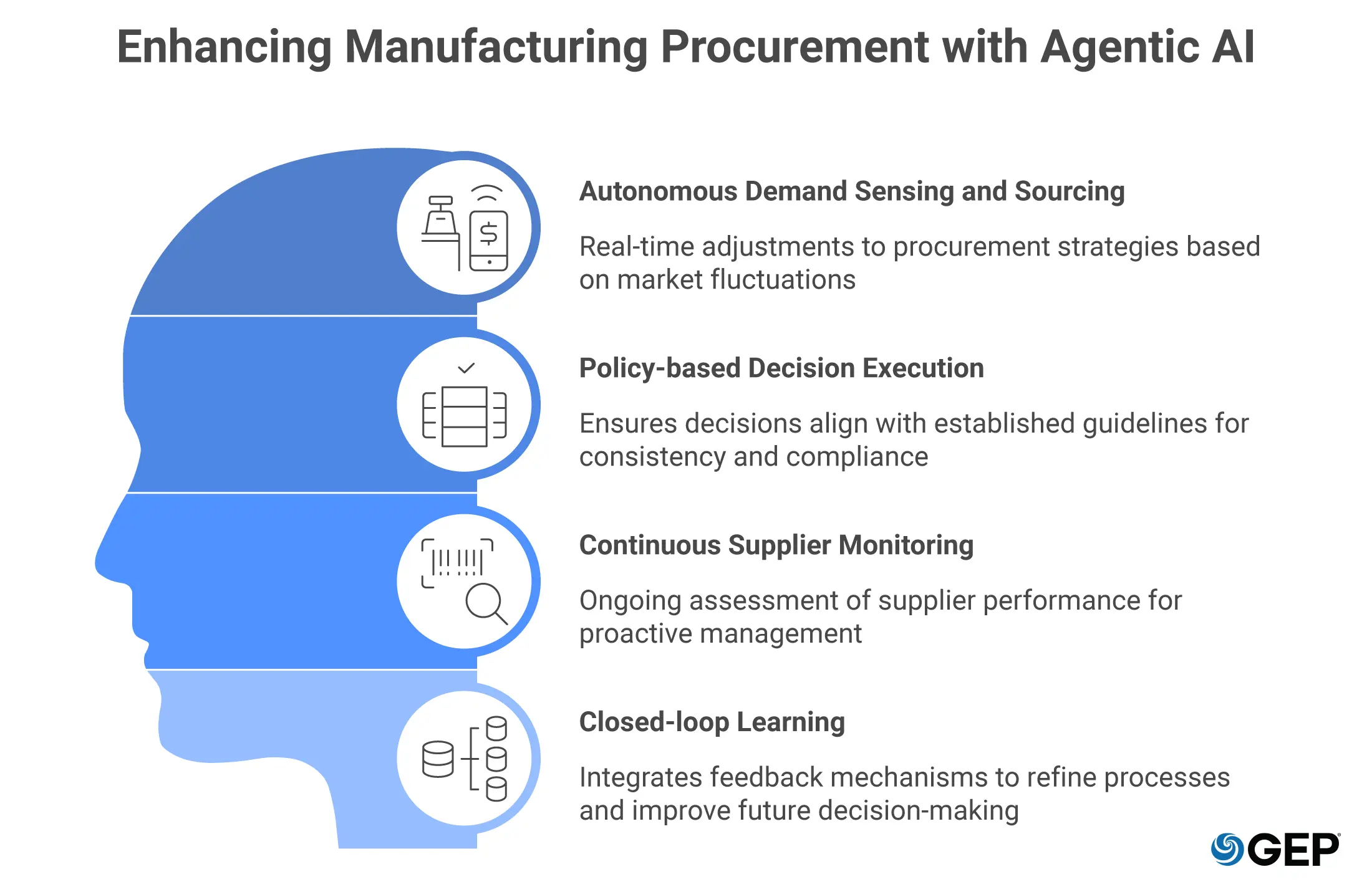
Autonomous Demand Sensing and Sourcing
Manufacturing demand rarely stays stable. Agentic AI continuously reads production plans, inventory positions, and historical consumption. When thresholds are crossed, it initiates sourcing events or releases purchase orders without waiting for a planner to intervene. Buyers step in only when exceptions surface.
Policy-based Decision Execution
Many procurement decisions follow repeatable rules. Preferred suppliers, price bands, lead-time tolerances, and ESG requirements already exist on paper. Agentic AI encodes those rules and enforces them consistently. That removes subjective judgment calls that often lead to rework or compliance gaps.
Continuous Supplier Monitoring
Humans cannot monitor supplier risk in real time across hundreds of vendors. Agentic AI can. It tracks delivery performance, quality signals, financial risk indicators, and regulatory changes. When risk scores rise, the system reroutes demand or pauses awards before disruption reaches the factory floor.
Closed-loop Learning
Each sourcing event improves the next one. Agentic AI compares expected outcomes against actual results such as price variance, on-time delivery, and defect rates. Those outcomes feed back into future decisions. Human teams rarely maintain that feedback discipline at scale.
Research from GEP shows that manufacturers using agentic AI procurement orchestration report shorter cycle times and fewer compliance issues once decision execution shifts from people to systems.
Real-World Use Cases of Agentic AI Reducing Human Dependency in Manufacturing Procurement
Direct Material Sourcing Under Volatility
Tariff changes and commodity swings create daily sourcing pressure. Agentic AI models alternate supplier scenarios automatically. When cost thresholds breach limits, it triggers negotiations or alternate awards. Teams avoid late-night escalations and rushed decisions during market shocks.
Tail-spend Automation in Plants
Maintenance and indirect materials often drain buyer time without strategic payoff. Agentic AI validates requests, checks contracts or catalogs, and places orders autonomously. Human effort shifts away from low-value buying and toward production-critical categories.
Supplier Onboarding and Compliance
Manufacturers face growing regulatory scrutiny. Agentic AI validates certifications, checks sanctions lists, and also enforces approval flows before suppliers transact. Errors that once surfaced during audits now get blocked upfront.
Production Continuity During Disruption
When a tier-two supplier fails, speed matters. Agentic AI identifies alternate suppliers, evaluates qualification history, and initiates sourcing workflows immediately. Humans approve outcomes instead of scrambling to assemble data.
More than 60% of organizations in the U.S. plan to invest in agentic AI to reduce reliance on manual decision-making in procurement by the end of 2026.
Explore 101 AI Use Cases
Real-world use cases that show how AI is transforming every stage of procurement
The Way Forward: The Impact of Agentic AI in Reducing Human Dependency in Manufacturing Procurement
Manufacturing procurement does not fail because teams lack skill. It fails when humans are forced to manage volume, speed, and complexity that exceed practical limits.
Agentic AI in manufacturing procurement reduces dependency by absorbing routine decisions and executing them reliably. It does not remove accountability. It changes where attention goes. Procurement professionals gain time to manage suppliers, support innovation, and protect production continuity.
Manufacturers that adopt agentic AI early will see fewer disruptions, cleaner audits, and faster response times. Those that delay will keep adding headcount to manage work that systems can already handle better.
Discover GEP’s AI Based Procurement Software



FAQs
Agentic AI enforces policy and data validation before actions execute. That prevents errors caused by incomplete information or inconsistent judgment. Over time, fewer corrections and approvals shorten procurement cycle times.
Agentic AI can manage complexity within defined guardrails. High-risk or novel scenarios still route to human review. Routine complexity, which makes up most manufacturing procurement work, runs autonomously.