


Struggling to Make Sense of Spend Data? Get AI Agents to Reshape Spend Consolidation
- Compared to traditional spend consolidation, the new generation of AI agents offers improved visibility and savings opportunities.
- These agents move beyond simple automation by proactively planning, iterating complex decisions and orchestrating multi-step spend consolidation workflows.
- Companies must assess their data infrastructure and readiness for change to fully capitalize on the competitive advantage agentic AI offers for managing enterprise spend.
December 09, 2025 | Procurement Software 5 minutes read
Spend data is often fragmented across multiple business departments and systems. How can businesses bring this data together to maximize purchasing leverage and mitigate risks?
For years, this process has been cumbersome, reliant as it is on manually connecting disparate data and slow reporting. Traditional automation was limited to rigid, rules-based tasks like invoice matching.
A fundamental shift is now underway, driven by AI agents, autonomous, goal-directed software entities that can observe, plan and execute multi-step financial and procurement workflows with minimal human intervention. AI agents represent the leap from informed insight to intelligent, continuous action, and they’re fundamentally reshaping how procurement teams manage enterprise spend.
Exploring the Role of AI Agents in Spend Consolidation
Machine learning (ML) paved the way for AI agents. The first generation of AI excelled at data preparation, which is essential for any strategic consolidation.
This foundational AI is indispensable for:
Data Cleansing and Normalization
Using natural language processing (NLP) to unify supplier names (e.g., "IBM" and "Int'l Business Machines Corp") and standardize inconsistent data across global systems.
Spend Classification
Accurately and consistently mapping every line-item expense (like software or utilities) to a granular taxonomy, creating a single, accurate "spend cube."
Anomaly Detection
Instantly flagging duplicate invoices, unusual price spikes or off-contract spending patterns that signal risks or opportunities.
This earlier AI provides insights that tell a procurement manager what they need to do. Agentic AI, however, takes the next step and begins to do the work for them.
How Agentic AI Transforms Spend Consolidation Beyond Automation
The transition to agentic technology marks a crucial break from the simple "report and recommend" model. Traditional automation (RPA) follows a strict sequence: If X happens, then do Y. Agentic AI, conversely, is goal-directed and proactive.
An AI agent is designed to achieve a high-level goal, such as "Reduce IT software fragmentation by 15%." It doesn't wait for a human prompt; it observes the environment (spend data, contracts), formulates a multi-step plan, and then begins to execute it, adapting its strategy based on real-time feedback.
Consider this hypothetical workflow:
A traditional system would simply alert an analyst that 15 separate teams are subscribing to five different project management tools.
An AI Agentic System would:
Plan
Identify the most-used tool and propose a bulk, enterprise-wide license negotiation.
Execute
The agent autonomously interfaces with the vendor's system to initiate the new contract tier. It drafts a compliance plan, sends 'sunset' notices to teams using unwanted tools and sets up automated checks to prevent future fragmented purchases.
Flag
It only flags the human manager for the final legal review and critical stakeholder approval.
This combination of autonomy and iteration is the key differentiator. AI Agents are continuously learning and applying that knowledge across the consolidation workflow, from complex intercompany eliminations during the financial close to initiating a new vendor sourcing event. They shorten the entire insight-to-savings cycle from months to days, allowing finance and procurement teams to focus entirely on high-level strategy and complex exceptions.
Explore GEP’s – Spend Management Software
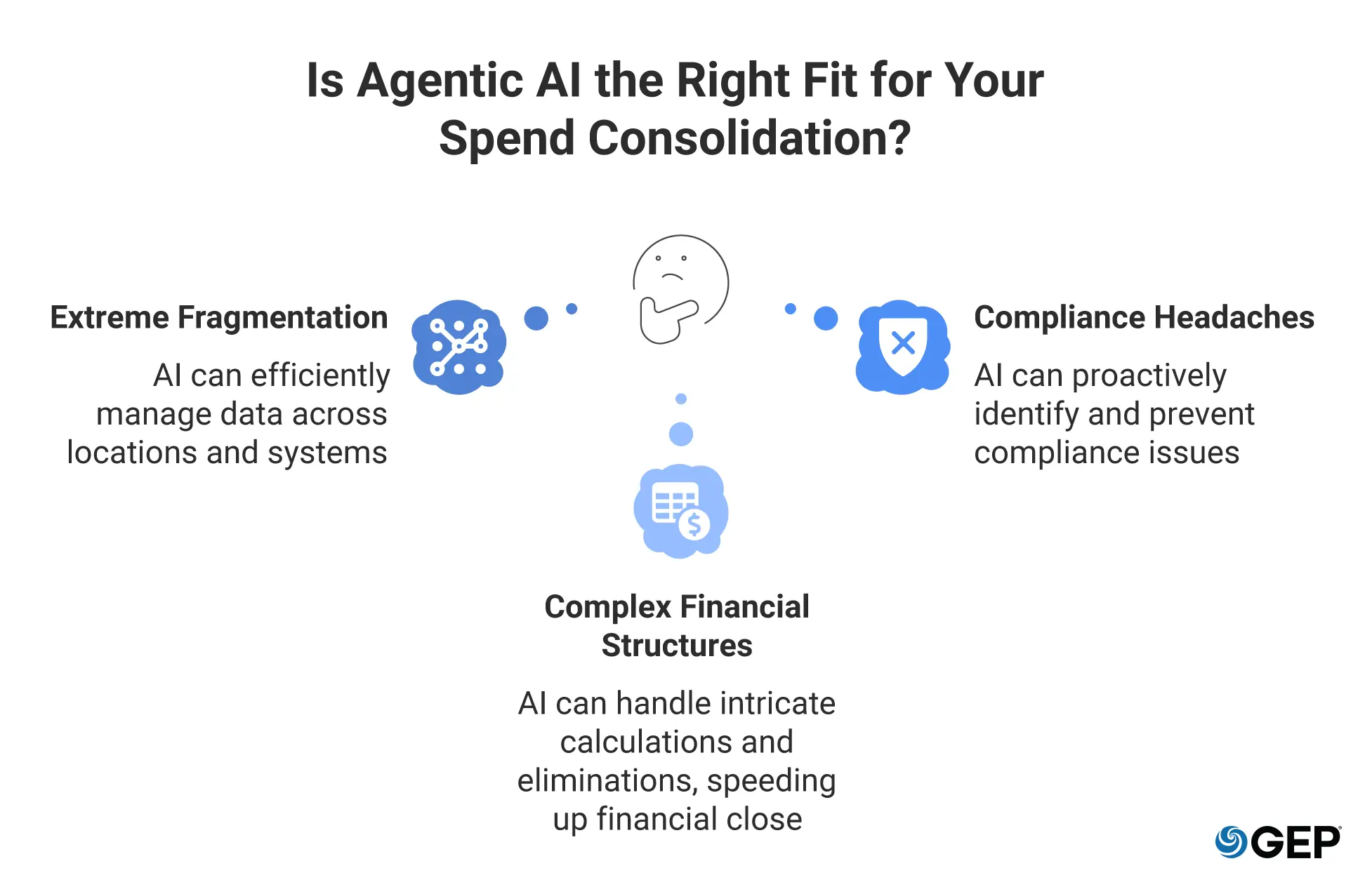
Assessing Whether Agentic AI Is the Right Fit for Your Spend Consolidation Needs
Agentic AI is a serious investment that pays off big in specific situations. Here's how to figure out if it makes sense for your organization.
You're probably a good fit if you're dealing with:
You're probably a good fit if you're dealing with
Your company has dozens of locations or divisions, each doing their own thing with different procurement systems. Your spend data is everywhere, and pulling it together manually takes forever. An AI agent can tackle that chaos much faster than throwing more people at the problem.
Complex Financial Structures
You're managing multiple entities, going through mergers and acquisitions, or constantly dealing with intercompany eliminations that make your accounting team want to quit. Agents can handle these complicated calculations on their own, cutting weeks off your financial close.
Real Compliance Headaches
You need to catch problems before they happen, not discover them months later in an audit. An agent can stop a purchase order if a supplier suddenly becomes risky, preventing issues rather than just documenting them.
But here's what you need before any of this works:
Your data has to be in decent shape. Not perfect, but good enough that an agent has something solid to work with. And your leadership team needs to be comfortable letting AI make real decisions about spending. That's a big cultural shift—going from "let's review what happened last quarter" to "we trust the system to make calls in real-time."
If you don't have those two things—decent data and executive buy-in—you're not ready yet. Fix those first.
The Agentic AI Inflection Point
The journey in spend management has moved from basic automation, through ML-driven analytics to identify opportunities, and has now arrived at the inflection point of agentic AI, which executes the consolidation autonomously.
As AI agents take over the monotonous, transaction-heavy and recurring tasks of spend consolidation, they will empower human procurement teams to become true strategic partners and focus on complex contract negotiations, vendor relationships and strategic planning that only human intuition and judgment can deliver.
For enterprises, the decision is no longer about whether to use AI to consolidate spend; it’s about when to embrace its fully autonomous, agentic capabilities.




FAQs
AI agents constantly watch where money goes across your organization, which enables them to spot opportunities to consolidate purchases. For example, they might identify that five departments are buying from different suppliers and kick off negotiations to move everyone to one better contract. They handle the whole workflow across various systems without someone having to manually coordinate it all.
The biggest wins are speed and savings. Your financial close happens faster because the data's already clean and organized. You save money in real-time because the agents catch non-compliant spending before it happens, not months later during an audit. And your procurement team stops drowning in spreadsheets and can focus on actual strategy instead of data cleanup.
They build the rules right into the process. Every transaction gets checked against your policies and contract terms as it happens. If something doesn't look right (maybe it's over budget, outside approved vendors, or just suspicious) the agent flags it or stops it on the spot. They also keep an eye on supplier risk, so you're not caught off guard if a vendor becomes problematic.