



How Does Autonomous Procurement Handle RFx Processes?
- Autonomous procurement eliminates hours of manual work by automating supplier evaluations, data management, and compliance tracking throughout the RFx lifecycle.
- AI-driven RFx tools analyze supplier responses at scale, scoring proposals against predefined criteria without human bias or fatigue.
- Organizations using automated RFx process management report faster cycle times and more strategic use of procurement talent.
February 19, 2026 | Procurement Software 5 minutes read
Anyone who's run an RFx process the old way knows the pain. You draft documents, chase down supplier responses and then spend days comparing proposals in messy spreadsheets. It's slow, boring work that pulls your best people away from their core tasks.
Autonomous procurement, powered by AI agents, is changing this picture. Unlike basic automation that follows rigid scripts, agentic AI deploys specialized software agents that can plan, decide and act on their own.
With AI to handle the grunt work, your team can run requests for information, proposals and quotes without all the manual drudgery. But autonomous procurement doesn't just make things faster. It changes how procurement teams work with suppliers and make sourcing calls.
Understanding RFx Processes and Their Importance in Procurement
RFx is just a catch-all term for the formal requests procurement teams send out to suppliers:
- Request for Information gathers basic info about what a vendor does
- Request for Proposal asks for detailed solutions and pricing on complex projects
- Request for Quotation zeros in on price for things you've already spec'd out
Why bother? Because it keeps things fair. Without a solid process, you end up picking suppliers based on gut feel, old data or who you had lunch with last. A good RFx levels the playing field and gives you real information to work with.
The catch? Traditional RFx eats up a ton of time. Your team writes documents, blasts them out to dozens of vendors, fields questions, collects responses, and builds comparison charts. The process can drag on for weeks.
How Autonomous Procurement Enhances Supplier Evaluation in RFx Processes
You've got thirty proposals sitting in your inbox, each one laid out differently. Reading them all takes forever.
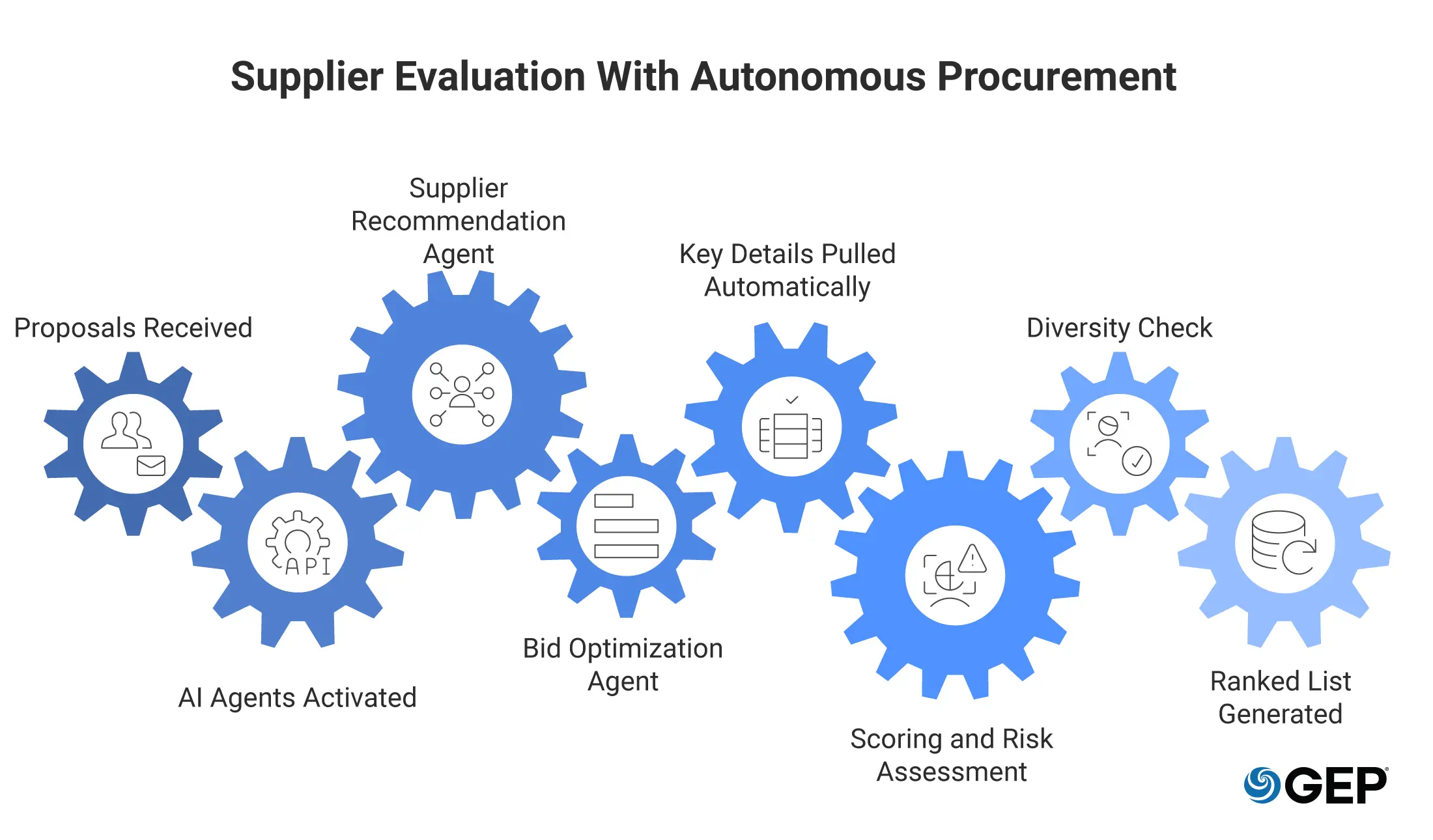
Supplier evaluation automation fixes this through specialized AI agents. A Supplier Recommendation Agent, for example, can suggest preferred vendors based on past performance, risk profile, geography, and diversity status. Meanwhile, a Bid Optimization Agent helps model award scenarios using pricing data, performance history and your specific constraints. An AI-driven RFx process reads through every submission, pulls out the key details and scores them against your criteria.
Those thirty proposals? Your autonomous procurement system’s agents work together to score each response on cost and service levels, flag risk factors and check diversity credentials. A few hours (not weeks) later, you get a ranked list with backup data.
Role of Autonomous Procurement in Optimizing RFx Data Management
RFx creates a lot of paperwork: supplier details, price quotes, tech specs, compliance docs, etc. Most teams end up with bits and pieces scattered across email chains, shared folders and random spreadsheets. Finding anything later becomes impossible.
Automated RFx process management puts everything in one place from day one. Agentic AI connects your ERP, supply chain systems and external data sources. Every email, every doc version, every note feeds into a single system that the agents can access and act on. You get a clear trail of who did what and when.
But the real payoff comes when AI agents start spotting patterns in your RFx data. A Market Intelligence Agent can analyze price trends and cost structures to surface sourcing opportunities you'd otherwise miss. A Spend Analysis Agent flags anomalies and inefficiencies. This is how you enhance procurement efficiency through RFx automation—and build up know-how that keeps getting better over time.
How Autonomous Procurement Automates the RFx Process
Agentic AI doesn't stop at scoring. Need to write an RFx? A Requisition Analyzing Agent reviews intake requests and suggests the best sourcing path. Other agents draft templates based on your category and past projects. You review and tweak instead of starting from scratch.
The procurement system finds the right suppliers, sends invites and tracks who opens what. A Quick Quote Agent accelerates low-value sourcing by launching RFQs and recommending awards for straightforward buys. A Strategic Sourcing Agent supports complex events with guided strategy.
RFx automation tools really earn their keep when responses come in. Agents check if submissions are complete, grab the key data and start scoring right away. A Negotiation Agent can recommend counteroffers in real time. This way, when the deadline hits, your team has a summary view and not a stack of PDFs.
The best platforms plug into your other systems through agentic integration. If you want to learn how to automate RFx processes in procurement, think bigger than one task. Teams that integrate AI in the RFx process see gains across the whole operation.
See Agentic AI in Action
Learn How GEP Quantum Intelligence’s Coordinated Agents Are Remaking Procurement Workflows
Benefits of Using Autonomous Procurement for RFx in Enterprises
RFx that used to take six weeks might wrap up in two. That speed lets you jump on market shifts before your rivals.
Money savings come from several places at once. Your team spends fewer hours on routine work. AI agents improve terms through better negotiation support. Built-in guardrails and audit trails ensure governance happens automatically, not as an afterthought.
Suppliers notice the difference too. They trust that their bid will get a fair shake. That reputation draws better vendors to your next RFx.
The biggest win? Your procurement pros can finally do real strategic work. They can dig into market trends and build smarter category plans. When you're thinking about how to choose the right RFx automation tools, ask whether the platform's AI can truly orchestrate work end-to-end and whether they'll adapt as your needs change.
Autonomous Procurement Turns RFx From a Chore Into an Edge
When agentic AI handles the document prep, the back-and-forth with vendors, and the response scoring, your team gets more done and makes sharper calls.
This shift is already happening. Companies that adopt AI-driven RFx processes are closing deals faster and building better supplier ties. The ones still doing it by hand are going to feel the gap grow.
If you're ready to see what autonomous procurement could do for your RFx work, autonomous procurement orchestration software is a good place to start exploring.




FAQs
Autonomous procurement uses AI agents that score every response the same way, using the criteria you set. The result is supplier evaluations based on what suppliers can actually deliver.
Agentic AI platforms include built-in guardrails, audit trails and policy enforcement. Every decision made gets logged automatically. When auditors or stakeholders ask questions, you've got a clear paper trail ready to go.