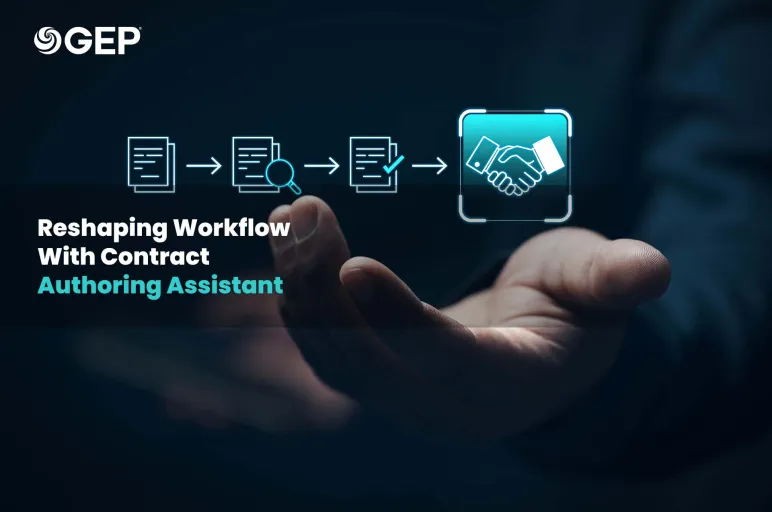
How Contract Authoring Assistant Reshapes Procurement Workflow
- The assistant reduces drafting work and shortens legal review queues by generating complete, compliant drafts from the start.
- It maintains alignment with internal risk and compliance rules by selecting only approved clauses for each contract.
- It accelerates the time-to-signature by removing manual assembly and reducing back-and-forth between procurement and legal.
November 26, 2025 | Contract Management 5 minutes read
Businesses still struggle with contracts even after years of digitization. Intake may be organized, sourcing may be automated, but contract creation often drags. Drafts bounce between procurement and legal, clauses get copied from old agreements without checking if they match current policy, and small errors stall deals. Cycle times grow, and stakeholders grow frustrated as contracts become the bottleneck.
The Growing Pressure on Contract Creation
The workload keeps rising. Categories expand, regulatory demands tighten, and supplier relationships carry more operational risk. Legal teams cannot scale at the pace of new requirements. Procurement teams try to fill the gap, but few buyers feel confident drafting language that satisfies both protection and speed.
Daily operations make the problem obvious. Buyers write drafts in Word, search old folders for clauses, stitch them together, then wait. Legal flags inconsistent language, outdated terms, and missing protections. The draft returns to procurement, which adjusts it and sends it back again. Many organizations underestimate how much time this loop consumes until delays disrupt downstream operations. GEP data shows that contract creation and review remain among the top contributors to long cycle times in source-to-contract processes, especially when clauses lack standardization.
A contract authoring assistant addresses that tension. It delivers something steadier than manual drafting: a clean, reliable first version built from deal context, category norms, negotiation goals, and pre-approved clause libraries. The work shifts from writing to validating.
Take Your CLM to the Next Level With AI
Connect with GEP’s experts for guidance and next steps to accelerate your transformation
Why Generic AI Tools Still Fall Short
Many teams turn to general-purpose AI tools as a shortcut. They paste an old contract into a model, ask for revisions, and expect compliant wording. The output sounds polished but breaks under review. Models can produce fluent text without enforcing policy. They mix clauses from unrelated categories, misinterpret risk expectations, or invent wording that conflicts with current rules. Legal must correct the draft, and send it back to procurement.
These tools lack access to the organization’s approved clause library. They lack historical agreements, fallback positions, and structured memory. Procurement teams notice immediately. Drafts look refined but fail compliance checks. Legal teams lose trust.
CLM platforms face their own limits. They store templates but keep relying on users to assemble clauses manually. Procurement teams still copy text, adjust formatting, and fix cross-references. Even small inconsistencies slow down the entire process. Legal must review every detail, and queues grow.
This is why cycle time improvements stall. Gartner notes that contract digitization improves visibility but does not speed authoring unless the system applies compliance rules automatically.
What a Contract Authoring Assistant Changes
A contract authoring assistant fills this gap. It reads the sourcing event or intake request, identifies category, risk level, commercial model, and negotiation goals, and selects the right clauses from an approved library. It checks them against internal rules and recent updates. It assembles a full draft with consistent formatting, definitions, and cross-references.
Legal receives drafts that already follow policy. Review shifts from rewriting to targeted checks. Research shows that standardized clause libraries paired with guided automation can reduce legal review workload by up to 30%.
The assistant also prevents clause drift. Many teams reuse outdated contracts because they are convenient. Over time, dozens of versions circulate. Compliance teams lose track of which ones remain approved. The assistant stops this drift by pulling only current language.
Negotiation becomes clearer. Suppliers see consistent language rather than unpredictable edits. Fallback clauses appear only when needed. Procurement gains flexibility without creating compliance exposure.
Upstream and Downstream Gains
Stakeholders outside procurement feel the shift. Business users get quicker updates. Finance receives predictable payment structures. Risk and compliance teams see how clauses were selected. Auditors find traceable drafts instead of unstructured notes.
The improvement shows up in throughput. Errors surface early. Conflicts no longer add days to contracting. The assistant corrects structural problems before draft review begins.
The effect spans categories. Routine contracts move quickly. Complex agreements start from a correct baseline instead of a recycled template. Multi-party agreements follow a stable structure because the assistant enforces consistency.
Contract Authoring Assistants connected to agentic AI inside procurement platforms strengthen orchestration. They pull sourcing data, supplier risk signals, performance history, and policy shifts. They apply sustainability, data-residency, and performance terms without manual checks. Contracts reflect upstream decisions and maintain links to the data that shaped them.
Explore 101 AI Use Cases
Real-world use cases that show how AI is transforming every stage of procurement
How Procurement Software With AI Agents Solves the Issue
Procurement software with agentic AI turns contract authoring into a guided, reliable workflow. AI agents gather context, select clauses, assemble drafts, apply compliance rules, and validate structure before anyone sends a document forward. They record every choice. They respond the same way each time because they follow a single set of rules.
Implementation becomes manageable when rolled out in phases. Build a clean clause library. Align procurement and legal on fallback rules. Connect sourcing, intake, and CLM so context flows automatically. Introduce the assistant in low-risk categories. Validate accuracy, refine, and expand. Trust grows as behavior stays consistent.
A contract authoring assistant reduces drafting effort and review cycles, and keeps agreements aligned with policy each time. It gives procurement and legal a way to meet rising workloads without slowing the business.
Looking Ahead: Contracting Enters a More Predictable Era
Organizations moving toward agentic procurement will gain steadier control over contract creation. The drafting process shifts from manual assembly to structured, context-driven authoring. Teams can plan around predictable cycle times instead of reacting to delays. Legal teams can use their capacity for higher-risk reviews. Procurement can support more categories without adding staff.
As AI agents begin to operate across sourcing, contracting, and supplier management, contract authoring becomes part of a wider operational flow that removes friction instead of adding it. The shift marks the start of a contract process built on clarity, consistency, and sustained operational momentum.
Discover More: Contract Management Software Solutions