


A CPO’s Roadmap to Deploying Agentic AI for Global Enterprises
- Agentic AI helps CPOs move from basic automation to true autonomy.
- It enables real-time decision-making and seamless cross-functional collaboration.
- Learn how procurement can become intelligent, adaptive, and self-governing.
December 12, 2025 | Procurement Software 5 minutes read
As a CPO, you’re dealing with more volatility and growing pressures, all demanding real-time adaptability. Still, your procurement functions remain scattered, and workflows disconnected. You need a system that understands what the business needs, where your current trajectory is heading, and how to deliver the right action precisely at the right moment.
This is where Agentic AI steps in.
Agentic AI enables procurement systems to think, reason, and act autonomously, setting the ‘cognitive’ requisite sought by executive leadership.
For large-scale digital transformation, CPOs must follow a phased roadmap that deploys AI agents in three stages. Each stage represents a deeper level of intelligence, autonomy, and cross-functional orchestration. Let’s understand this better.
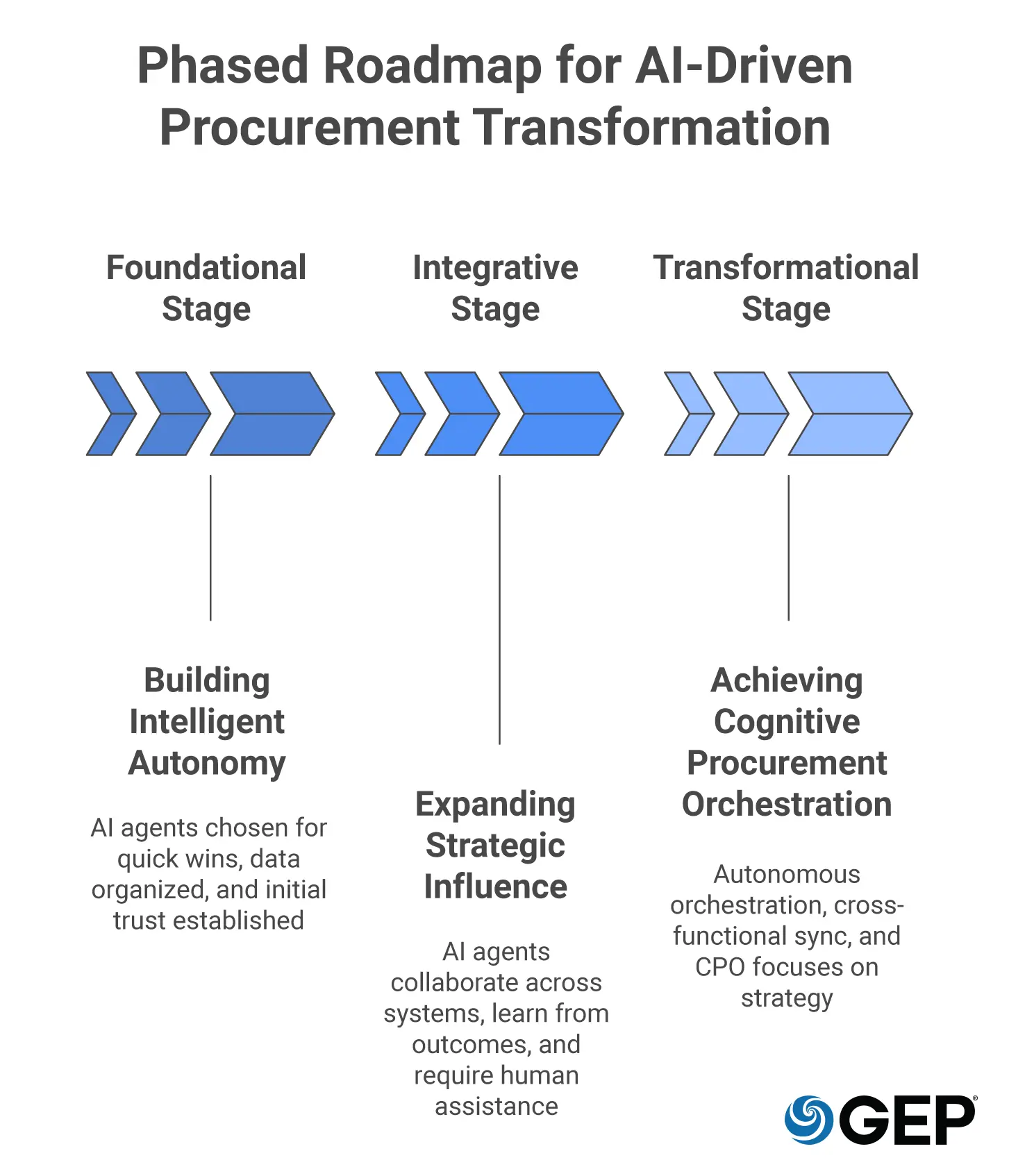
Foundational Stage: Building Intelligent Autonomy
The foundational phase establishes the readiness required for digital procurement while laying the groundwork for scalability across multinational enterprises.
Here, AI agents are chosen to work on high-impact areas that can deliver quick wins and measurable ROI. Organizations prepare by gathering, cleaning, and organizing data for AI agents. Goals and guardrails are set for specific functions.
This stage can help gauge the operational reliability of early AI agents, which act as assistants built to handle specific tasks autonomously. As they mature over time, these agents build user (employee and external stakeholder) trust, continue to self-learn, and evolve to handle more complex tasks.
Ready to put AI agents to work?
Explore what AI Agents can do for your procurement team
Key use cases that define this stage include:
Supplier Management
An agent gathers supplier data from databases and can dynamically score suppliers on performance, quality, delivery, compliance, and other formally agreed upon factors. It can maintain a “live supplier profile” that updates in real time.
Contract Lifecycle Management (CLM)
AI agents can interpret and monitor contract renewals and autonomously flag issues before they escalate. These agents can also simulate negotiations or offer recommendations based on their past learning.
Spend Intelligence and Cost Optimization
AI agents unify data across digital systems and detect savings opportunities based on spending patterns. This provides CPOs much-needed leverage for profitable buying and supplier negotiations.
Risk Monitoring and Intervention
Agentic AI monitors geopolitical, financial, and supplier performance indicators to identify early signs of disruption. When anomalies appear, it can trigger risk alerts or even initiate contingency sourcing. This helps CPOs recover faster from supply chain shocks.
The foundational stage gives you an AI-ready procurement function with measurable returns from early deployments.
2. Integrative Stage: Expanding Strategic Influence
Once the basics are in place, your focus as the CPO turns from parallel automations to collective cross-functional intelligence. At this stage, one agent’s output becomes another agent’s input.
At this stage, AI agents do not have complete decision autonomy and require human assistance and decision-making. AI agents collaborate across systems and gain context from shared data.
Agents will continue working within defined workflows and learn from the outcomes and decisions being made.
Key use cases include:
Supplier Collaboration
Autonomous systems can handle supplier conversations, follow performance trends, and link internal teams with the right partners outside the organization. They can also spot opportunities for shared research or product co-development, helping both sides innovate faster.
Demand Forecasting
AI agents predict demand using real-time market trends and gather insights from other systems like supplier, category, spending, etc., which are then used to balance capacity and enhance inventory operations.
Compliance and Audit Automation
Automated controls now review transactions in real time, flag irregularities, and test them against standards such as ISO, SOX, and CSRD. Every action is logged, creating a traceable audit record.
Sustainable or Ethical Sourcing
AI evaluates supplier sustainability performance, highlights non-compliance with regulatory standards, and offers teams better alternatives. The payoff protects profit while proving that responsible sourcing strengthens both operations and reputation.
In this stage, CPOs move from procurement automation to semi-autonomous coordination, where AI can support human inputs with complex decision-making while learning from every outcome.
Discover Now - Accelerate Connectivity with Agentic Integration
3. Transformational Stage: Achieving Cognitive Procurement Orchestration
This is where CPOs begin to realize autonomous orchestration. Systems can now reason through data, make decisions, and act without waiting for a human signal. The process keeps improving itself as it runs.
Different functions finally work together. Sourcing, contracting, forecasting, and compliance all move in sync, guided by shared data instead of separate workflows. This marks the transition from automation to orchestration. CPOs can now focus on how teams set strategic intent and let agentic AI handle operational execution.
Here’s what you get with agentic AI
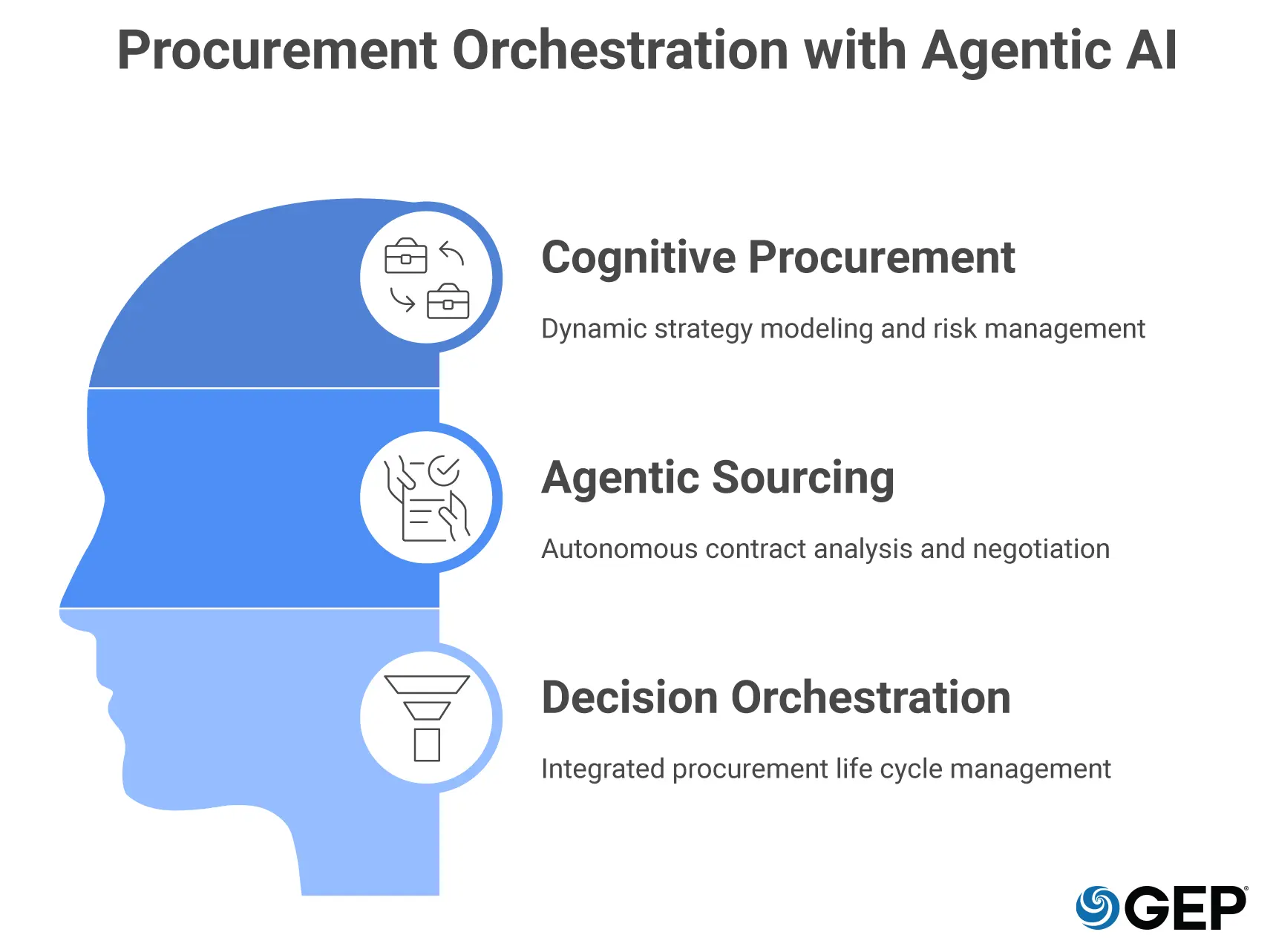
Cognitive Procurement
Agents dynamically model strategies for category management, simulate sourcing outcomes under different market conditions, apply cognitive risk management to those scenarios, and autonomously recommend actionable playbooks.
Agentic Sourcing and Negotiation
AI agents analyze contracts and produce negotiation briefs. Based on the protocols given, agentic AI can independently run RFx events, evaluate bids, and manage and negotiate contracts, compressing sourcing cycles from weeks to hours.
Decision Orchestration
At this stage, AI 'orchestrates' the complete source-to-pay procurement life cycle into one connected process. CPOs can achieve multi-function collaboration across all procurement functions and can optimize it even further to achieve broader business goals.
In this stage, procurement becomes truly cognitive and self-optimizing. It can autonomously create and adapt strategies based on multiple factors and live data, while ensuring that all decisions are made within governance protocols.
The Agentic AI Playbook for Procurement Pros
Your roadmap to moving from pilots to production, with AI that adapts, learns, and delivers
Technical Limitations and Challenges CPOs Face in Agentic AI Implementation
Agentic AI delivers value, but you’ll face predictable technical and organizational barriers like:
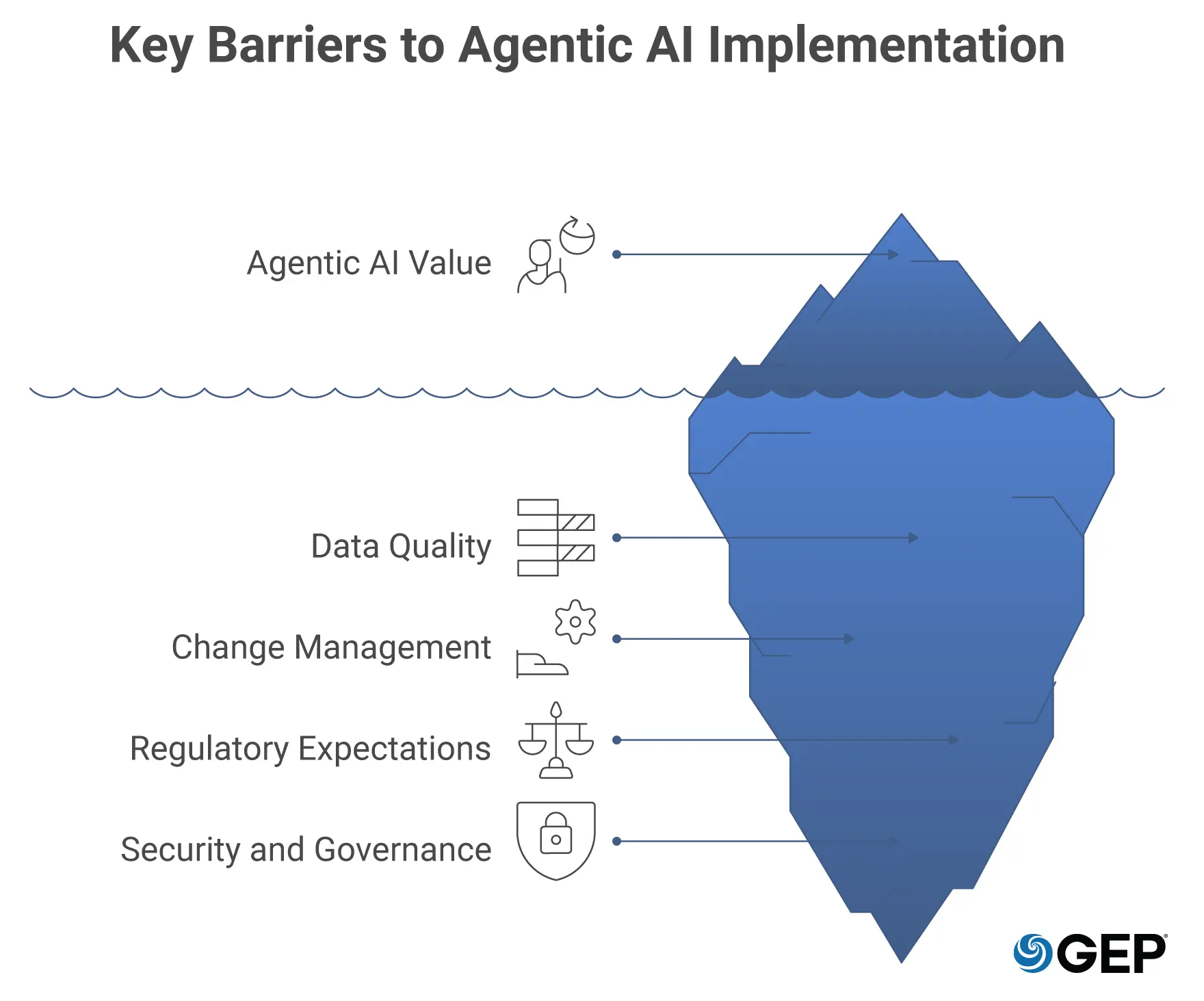
Data Quality and Integration
Agents need consistent, well-mapped data to work. Fixing master data, standardizing taxonomies, and building reliable APIs must come first. Without these steps, agents make inconsistent or misleading recommendations. Plan phased modernization with middleware and APIs to let agents access necessary signals.
Change Management and Talent
People need new skills and new roles. Train your teams to supervise agents rather than operate them directly. Create role definitions for human-in-the-loop tasks and for agents that escalate when exceptions occur.
Unclear Regulatory Expectations
Regulators may not have rules for autonomous procurement decisions yet. Document decision logic, maintain audit trails, and set clear escalation paths to satisfy internal and external auditors.
Security and Governance
Agents need access to sensitive supplier and finance data. Use strong identity controls, encryption, and least-privilege architectures. Log access and decisions for forensic review.
Agentic AI for Procurement Excellence
Agentic AI employs interconnected agents capable of independent reasoning, collaboration, and orchestration of procurement outcomes. CPOs that adopt Agentic AI early will transform procurement into a predictive, autonomous, and value-generating ecosystem.
The key is to start small, measure outcomes, and build governance that keeps humans in charge of boundary decisions.


FAQs
Agentic AI turns procurement into a strategic command center by giving you continuous market and supplier signals. You gain predictive foresight, real-time intelligence, and the ability to act autonomously inside agreed guardrails, so decisions happen faster and with more context. As agents learn from outcomes and feedback, they refine sourcing suggestions and risk alerts, which strengthens your strategic sourcing and enterprise collaboration.
Begin with workforce transformation. Build digital literacy, run small experiments, and put clear escalation paths in place so teams know when to trust agents and when to step in. Create roles such as AI supervisors and data translators to convert business priorities into agent guardrails. When agents remove repetitive work, your team can spend more time on supplier strategy, sustainability metrics, and high-value partnerships.