


8 Must-Have Features of Procurement Software
- The focus has shifted from digital procurement to intelligent procurement, as technology becomes capable of understanding the context, reasoning and decision-making.
- Choose a procurement-specific AI model that can generate relevant insights.
- While technology can take over routine tasks, maintaining human oversight remains critical for procurement.
February 17, 2026 | Procurement Software 4 minutes read
If you work in procurement, you know that things can change quickly in the current business environment. Demand, supply, input costs, buying patterns — all of these can change quite dramatically.
Businesses need teams as well as technological solutions that can withstand this uncertainty.
Procurement must be agile, resilient as well as flexible to adapt quickly to changing conditions. These qualities necessitate the deployment of advanced procurement technology.
The question now is: how do you zero in on procurement software that’s a perfect fit for your business? One that can deliver the desired outcomes, integrate with existing systems, and scale with business growth.
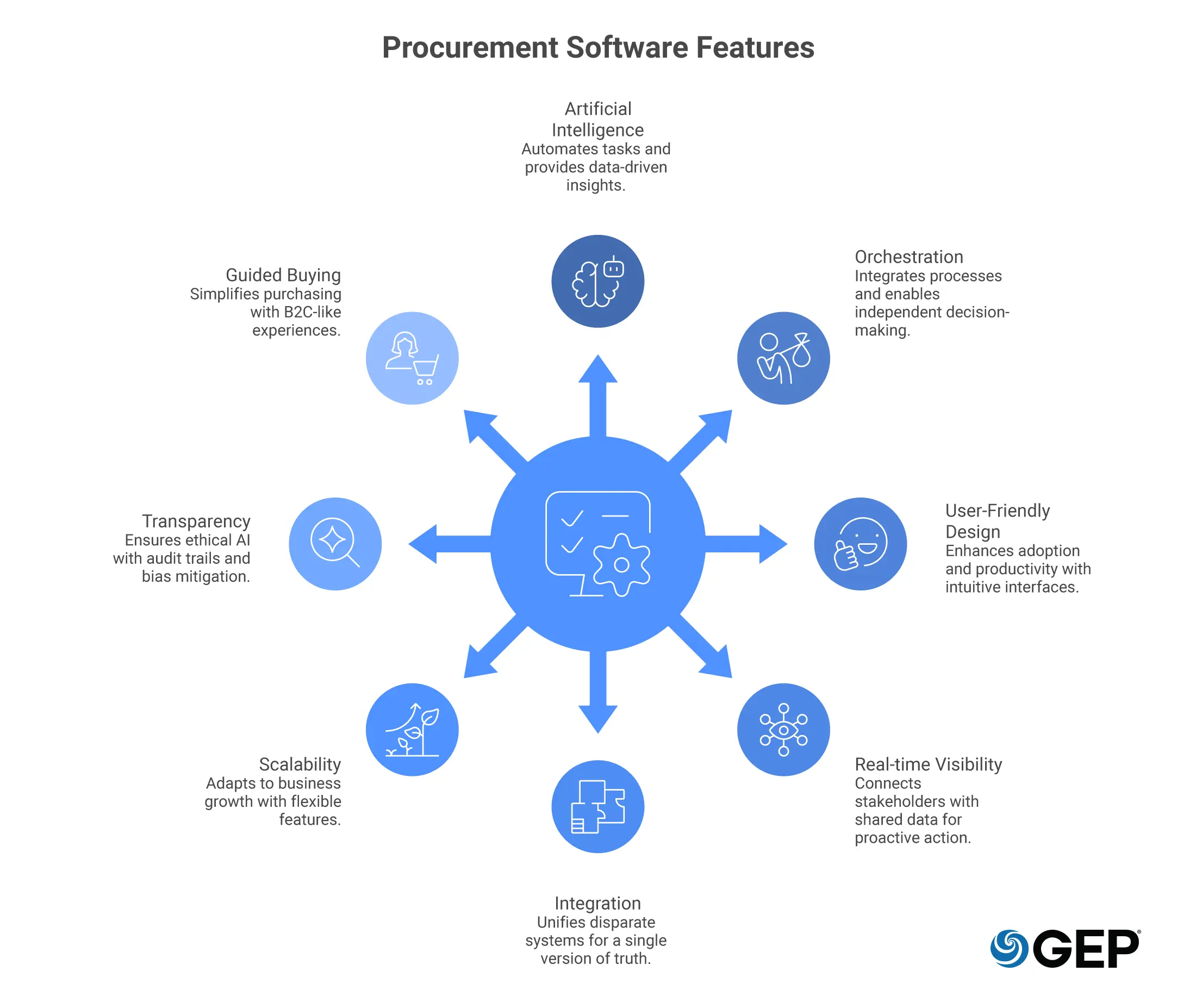
Here are some must-have features:
1. Artificial Intelligence
Artificial intelligence has changed how procurement operates. It has automated routine tasks in sourcing, contract negotiations, and supplier management. It has made life easier for professionals struggling with spend analysis and demand forecasting with tools that factor-in real-time market trends, historical data as well as consumer behavior. Look for AI models trained on procurement-specific datasets.
These can generate insights finetuned for category management, sourcing, contract risk, supplier performance, and invoice validation. These insights simplify decision-making and allow teams to do more with less effort.
2. Orchestration
Traditional automation can perform individual tasks in procurement. But it can’t eliminate functional silos and bring together procurement processes.
Agentic AI makes this possible by orchestrating the end-to-end process. From sourcing and contract negotiation to spend analysis, compliance and risk assessment, AI agents are now working with stakeholders to ensure seamless execution.
This marks a shift from rules-based tasks to independent decision-making with agentic intelligence. Armed with such intelligence, technology can understand the context, reason, decide, and even act within defined guardrails. It can also learn from outcomes and improve and adapt over time.
3. User-friendly design and mobile access
No less important is the user-friendliness of procurement software, as pointed out by many respondents in a GEP and SIG survey. They believe that a better user experience would “radically change their ability to execute and allow them to tackle new problems.”
Better user experience boosts adoption and has a positive impact across procurement and the overall enterprise. Users can leverage drag and drop tools to create or adapt approval flows, scoring models, and reporting dashboards.
The solution should have a clean and intuitive mobile interface that is easy to use and requires minimal training. With mobile access, teams can access dashboards, join sourcing events, and approve orders on the go.
4. Real-time visibility and collaboration
Different stakeholders in procurement can effectively work together if they can access the same data in real time. They should have complete visibility of what’s happening across the process. Such visibility connects the end-to-end process and allows teams to spot potential bottlenecks and act proactively.
5. Integration
In a large global organization, procurement is often spread out across legacy systems and disparate tools. It’s vital to have a procurement solution that connects these fragmented systems. This allows systems to talk to each other with a unified data model. It creates a single version of truth for all stakeholders.
6. Scalability
The procurement solution must be flexible and scalable to adapt to the organization’s growth. It should offer support for global operations with multi-entity, multi-currency, and multi-language capabilities. Look for customizable approvals, reporting tools, and features that can evolve to your business requirements over time.
7. Transparency
This is again a must-have feature. Look for procurement platforms that provide audit trails for AI-generated recommendations. The platform should clearly document the logic and data inputs behind AI decisions. It should also enable controls for ethical AI and bias mitigation.
8. Guided buying
The procurement platform should offer a buying experience similar to B2C ecommerce. It should guide users to buy the right things from pre-approved suppliers at the right, pre-negotiated price. A simplified buying experience will make purchasing easy for users and discourage them from buying off contract.
From Tasks and Workflows to Agentic Orchestration
Learn how GEP Quantum Intelligence is Redefining Procurement
Keep a Human in the Loop
Despite all that technology can do, maintaining human oversight remains critical for procurement. To do this effectively, identify areas where technology can do better than humans and vice versa.
Critical thinking and understanding of nuance will be your edge as procurement professionals, says Paul Blake, senior director engagement at GEP, in this GEP and Ardent Partners webinar.
The must-have human traits in procurement include strategic thinking, ethical guidance, negotiation for mutual benefit, and adaptability to changing conditions and social rules, he adds. Thus, while technology will allow procurement to do a lot more with less resources, human supervision and expertise will always be needed.




FAQs
AI automates routine tasks in sourcing, contract negotiations, and supplier management. In addition, AI models trained on procurement-specific datasets can generate insights finetuned for category management, sourcing, contract risk, and supplier performance.
By automating routine, time-consuming manual tasks, automation speeds up procurement workflows and frees up professionals for strategic and value-adding work.
Procurement professionals need mobile access to access dashboards, join sourcing events, and approve orders on the go. The procurement software should have a clean and intuitive mobile interface that is easy to use and requires minimal training.