



A Practical Guide to Real-Time Spend Classification Using AI Agents
- A context-aware AI agent classifies every transaction with real-time accuracy.
- You get reliable, structured, audit-ready categories at scale.
- Data remains clean, accessible, and usable even during volume spikes.
December 12, 2025 | Spend Management 7 minutes read
Procurement teams handle large volumes of spend data every day. But most of it lies in different systems with little to no structure. When that happens, leaders struggle to see what they’re spending, where the money goes, and which categories deserve attention.
The gap becomes even harder to manage as suppliers grow and business scales across geographies. This is where integrating an AI agent into spend classification makes an impact, particularly for multi-enterprise companies that require speed and accuracy at scale.
AI agents can give you cleaner data and clearer visibility by interpreting messy descriptions, matching patterns, and organizing every line of spend into a structure you can trust.
This article walks you through how AI-driven spend classification works, why it matters, and how an AI agent raises the quality of your spend data. You’ll see where these systems fit in your workflow, what benefits they bring, and what to expect when you deploy them.
The goal is simple: give you a clear, practical view of what this technology can do for your procurement operation.
What Is Spend Classification?
Spend classification is the step where you group every transaction into a category so your reports tell an accurate story. You need this foundation before any kind of analysis or savings effort can work.
An invoice line might say “Computer,” a purchase order might say “PC Purchase,” and the general ledger might tag it differently. Even with those mismatches, you still want all of them to land in a single category like IT Hardware.
That’s the core idea behind spend classification: you take every transaction and map it into the right part of your taxonomy.
Most teams rely on a standard structure such as UNSPSC or CPV, because it keeps your categories consistent from one business unit to another. A taxonomy like this lets you roll up spend, trace patterns across suppliers, and understand where the bulk of your costs sit.
Once your spend is classified, the data becomes far more useful. You can build reports that show category trends, manage budgets with fewer blind spots, and identify areas worth sourcing differently.
If the data remains unorganized, leaders struggle to see where money actually goes, and sourcing strategies often rest on partial information. A clear classification process removes that guesswork and gives your team the visibility they need to plan with confidence.
When your categories stay consistent, your entire analytics stack becomes sharper. This is the groundwork AI builds on later when it automates the process at scale.
Ready for Spend Data You Can Trust?
Learn how AI cuts cleanup cycles with structured data and clear reasoning to every record
The Role of an AI Agent in Spend Classification
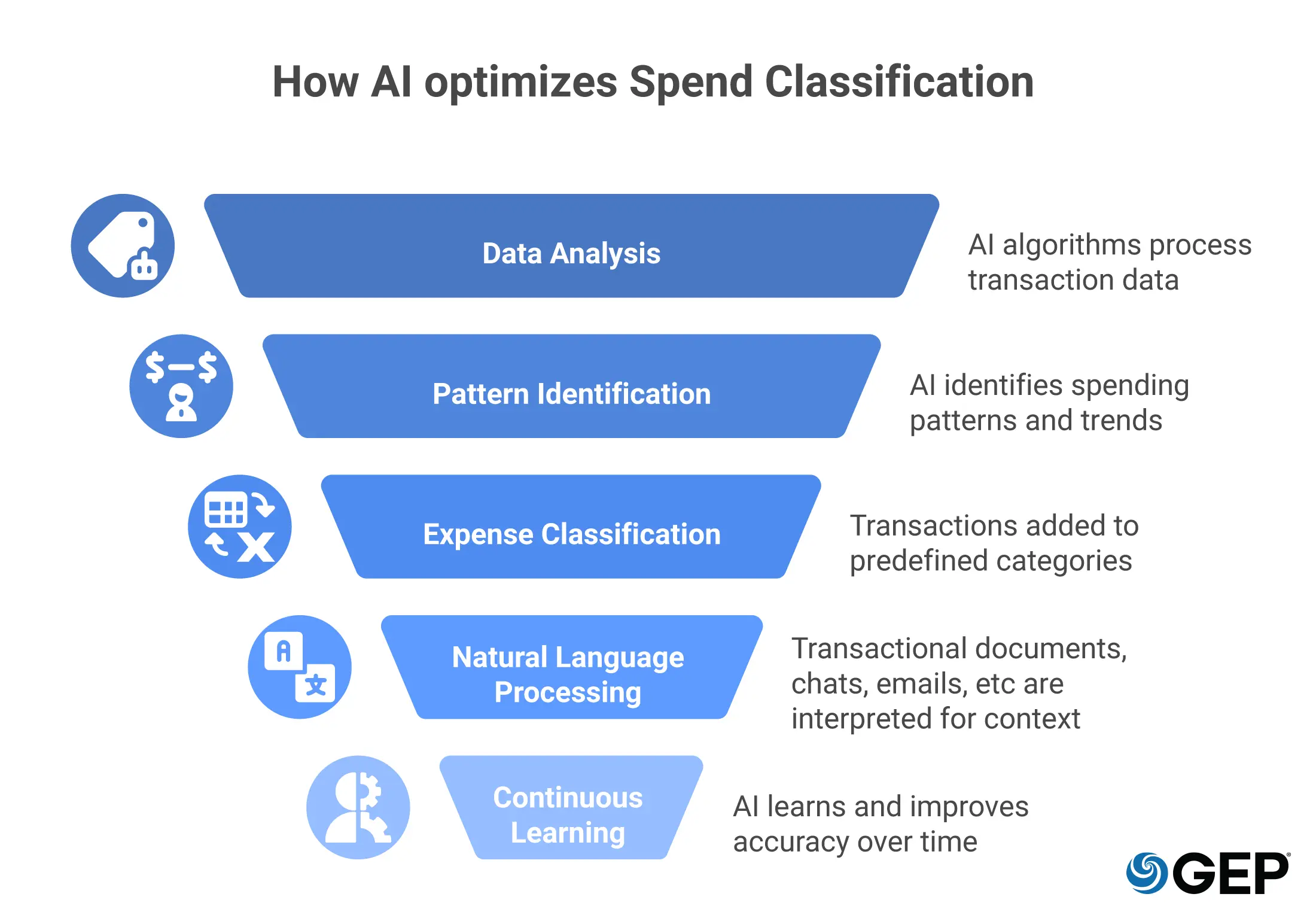
An AI agent pays attention to the details across all your systems. It analyzes item descriptions, supplier names, codes, and contract terms to determine where each line of spend belongs.
The agent reviews incoming transactions the moment they land. It picks up on patterns people tend to overlook, especially when the same item shows up under different labels. That learning gives you steadier categorization across the board.
You also get clear reasoning behind its decisions. The agent records how it reached a conclusion, so you can audit its judgment at any time. When category managers look at those explanations, they can fine-tune the system and correct anything that feels off. This learning from hands-on ways to tackle problems eventually strengthens the model and brings it closer to your business logic.
The model handles the repetitive work, and your experts guide the strategic boundaries. You’re no longer relying on fixed rules that break whenever a vendor phrases something differently. The model learns from examples and keeps improving as your data grows.
How AI Agents Transform the Spend Classification Workflow
An AI-driven classification flow gives you steady, predictable results by breaking work into steps that reinforce each other. You get cleaner data with far less strain on your team.
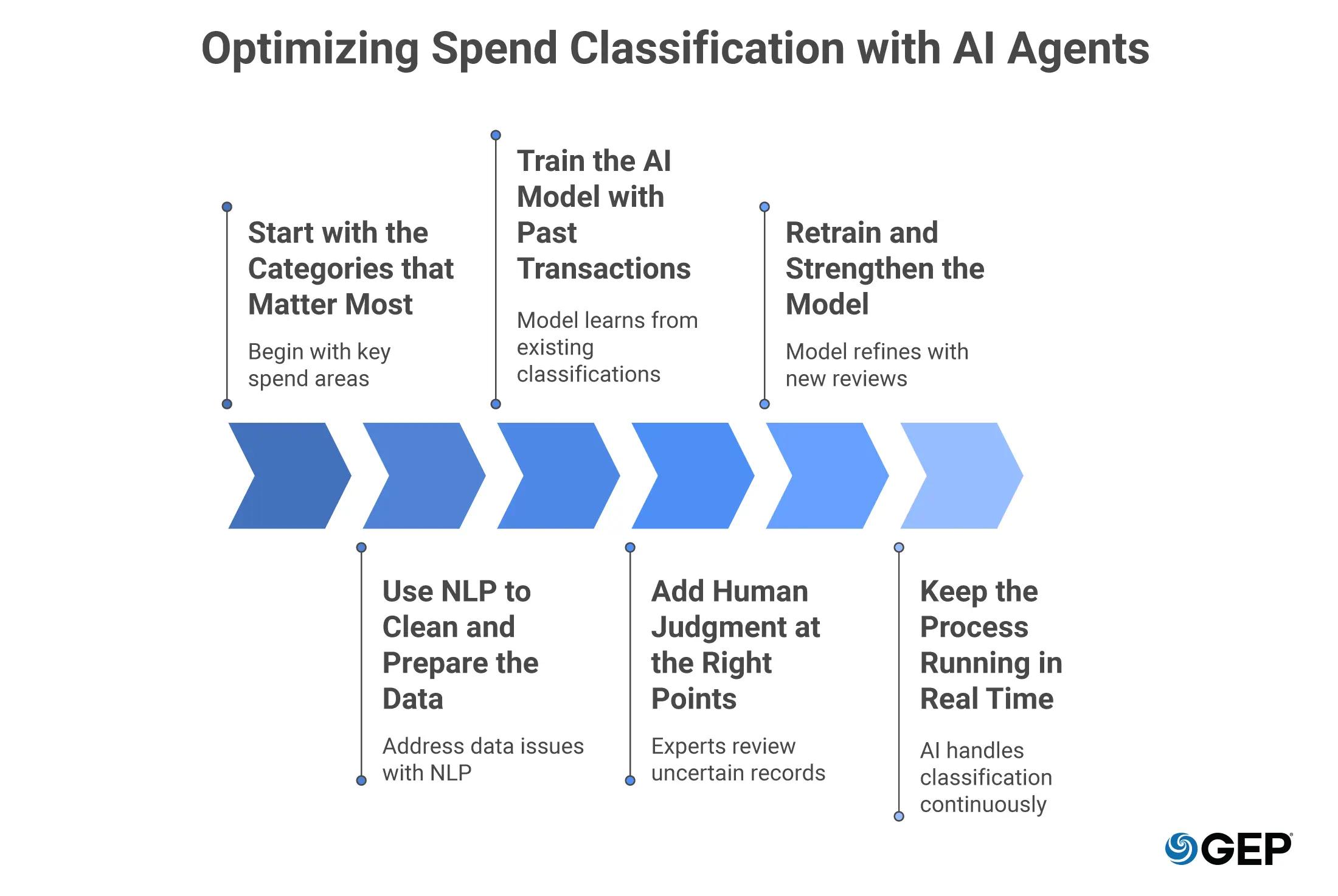
1. Start with the Categories that Matter Most
Begin with the spend areas that carry the most weight. Cleaning those up first gives you better visibility and shows where the real gaps are. A shared taxonomy keeps classification consistent across teams.
2. Use NLP to Clean and Prepare the Data
NLP addresses common issues in procurement data, such as misspellings, vague descriptions, and inconsistent naming. It gives you cleaner inputs without long cleanup cycles.
3. Train the AI Model with Past Transactions
The model learns from your existing classifications. It studies how items were grouped and applies those patterns to new transactions after training.
4. Add Human Judgment at the Right Points
When the agent isn’t confident about a record, it sends it to your category experts. Their corrections guide the model and cut down on unclear classifications.
5. Retrain and Strengthen the Model
Every new review becomes part of the model’s learning pool. The agent refines itself using those updates and gradually raises its consistency. Some systems enhance this step by pulling context from supplier or product information.
6. Keep the Process Running in Real Time
Once the workflow is active, the AI handles classification continuously. It highlights odd spikes, repeated entries, or anything outside your usual patterns. Your team gets current information instead of waiting for periodic refreshes.
When this workflow settles in, your analytics stabilize, and your team spends more time on decisions instead of cleanup.
GEP Spend Category Outlook 2026
See the critical risk signals and cost drivers that will shape enterprise-level spend across 19 direct and indirect categories worldwide.
Benefits of Deploying AI Agents in Spend Classification
An AI agent strengthens the way you classify spend by making the process accurate and fast. You get cleaner data and more dependable visibility without drowning your team in manual review.
Greater Accuracy and Consistency
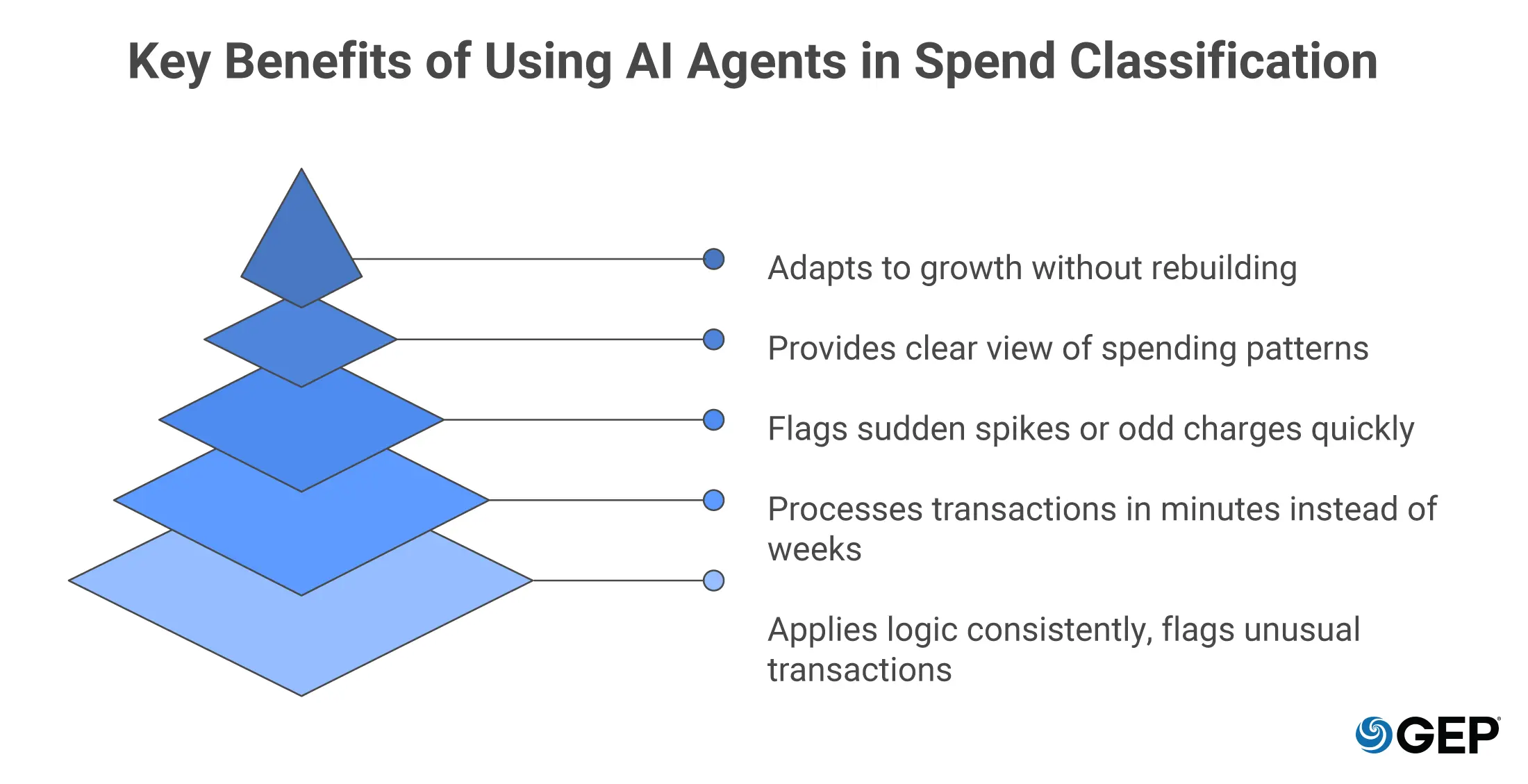
An AI agent applies the same logic every time it reviews a record, unless it detects an unusual transaction, in which case it immediately flags it. Many teams report big jumps in accuracy once the model settles into their environment, because the agent keeps learning from each correction your experts make.
Massive Time Savings
Manual classification is slow and tedious. When AI steps in, thousands of transactions get processed in minutes instead of weeks. Your team gets to shift their attention toward sourcing and planning instead of sorting through line items. It’s a noticeable lift in productivity.
Real-Time Insight
With the agent running continuously, your reports stay current. If a category suddenly spikes or a vendor pushes through an odd charge, the system flags it quickly. That helps you respond before small issues turn into costly ones. You move from chasing answers to staying ahead of them.
Improved Decision-Making
Accurate, structured data gives you a clearer view of your spending patterns. It brings together information from your ledger, purchase orders, invoices, and supplier records into a single picture. You can spot savings opportunities and tighten compliance with far more confidence.
Scalability and Agility
As your spend grows or your business expands into new categories, AI adapts without needing to be rebuilt. It handles large volumes, blends data from different systems, and gives you an audit trail that backs every classification decision. That makes it easier to maintain standards across the entire organization.
With these advantages, an AI agent turns your spend data into a reliable foundation for smarter planning and category strategy.
Get Audit-Ready Reports Every Time
When you let an AI agent handle the routine parts of spend classification, your data starts to settle into a shape you can trust. Reports update without waiting on someone to clean the backlog, and categories stay steady enough for your team to shift their attention to planning.
As the agent picks up more of your experts’ corrections, your view of where the money goes becomes clearer and easier to use.
This mix of automation and human judgment helps you spot issues early and make cost decisions with fewer unknowns. If you’re curious about how quickly it can change your workflow, try it on a small slice of your spend and see how fast the noise fades.
If you want to see what that looks like in practice, reach out, and we can walk you through how GEP’s AI-powered spend analysis software supports enterprises worldwide.




FAQs
An AI agent learns from your historical labels and uses that knowledge to recognize patterns in descriptions, supplier names, and item details. It handles the repetitive parts of classification and applies the same logic across every record, which reduces inconsistent tagging. Over time, the model improves as your team reviews low-confidence items and corrects them.
You’ll get better results when the agent has access to your purchase orders, invoices, receipts, and general ledger data. Supplier details and contract terms add helpful context. The model uses these fields to understand each transaction and place it in the right category. Even unstructured text fields are useful because the agent can process them with natural language techniques.
Traditional methods move slowly and rely on rules that don’t adapt well when your data changes. An AI agent takes in large volumes at once, studies past decisions, and recognizes similarities even when suppliers or descriptions vary. It also highlights unusual activity as it appears, which helps your team stay focused on review rather than cleanup.
Yes. Your category experts guide the model as it gets familiar with your data. The agent sends over any items it isn’t sure about, and your team reviews them so the system can learn the right patterns. You continue checking results at regular points to keep the classifications aligned with your business.
Data quality can slow progress when information lives in several systems or shows inconsistencies. Large taxonomies may also take time for the model to absorb. Your team needs space to get comfortable with how the agent works and what its outputs mean. A phased rollout with clear steps helps ease that transition and keeps the project moving smoothly.